Documentation / Opportunity Types / How to Find Radio Show Opportunities
How to Find Radio Show Opportunities
Find the radio shows and stations in your market, and the ones that take guests, sponsors, or advertisers.
What this type finds
The Radio Shows type finds the pages of radio programs and the stations that air them. It groups several kinds of pages:
- Show and program pages of terrestrial, satellite, community, and internet radio stations.
- Talk radio and call-in show pages, with the host, the topics, and the schedule.
- Station schedule pages and pages about the hosts of a program.
- Pages that tell you how to be a guest or give an interview on a show.
- Radio advertising pages and show sponsorship pages, with the ways to buy air time.
- Radio directories and lists of programs, where you can find shows in a region or on a topic.
The type identifies the page's form, not its subject. A page about a gardening show and a page about a finance show can both score high. Your campaign decides which subject comes first.
Why it matters
A radio show lets a business reach an audience that listens for a long time. A guest slot or an interview puts your expert in front of that audience. A show page can also name your business or link to your site.
The type fits a business with a local or regional audience, an owner or expert who speaks well, and a market with its own talk shows. It also fits a business that wants to buy air time or sponsor a program.
Find it in the web app
- Open Opportunity Types in the web app menu.
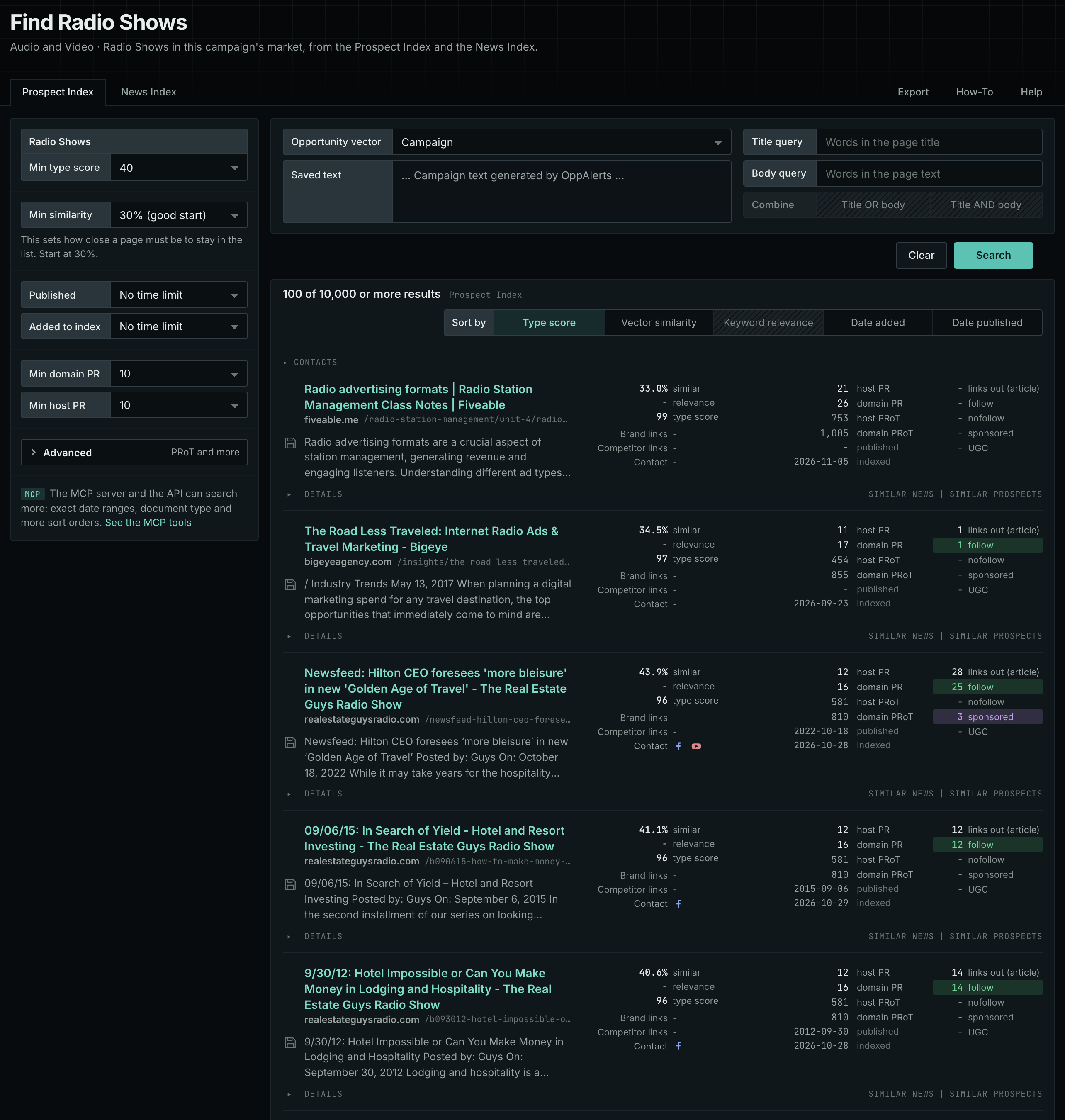
- Choose Audio and Video, then choose Radio Shows.
- Read the Prospect Index tab first. It holds the pages of all dates. Min type score defaults to 40. Raise it to see only the pages that match this type most closely.
- Click Vector similarity in Sort by to put the pages most similar to your market first.
- Open the pages of shows that fit your audience. Read what the show covers, who the host is, and how it accepts guests.
- Read the News Index tab for current pages. Set Published to the last few weeks.
Get new pages every day
- Open your campaign in Edit Campaign, and open the Opportunities tab.
- In Search for, choose Radio Shows, in the Audio and Video group. In Opportunity vector, choose Campaign. Click Add opportunity.
- Open the Daily Email tab, select the checkbox, choose the hour, and click Save.
Each day, the pages added to the indexes in the last 24 hours appear on the Dashboard tab and in the daily opportunities email. See Daily Monitoring and Alerts.
In MCP and the API
Two tools search this type. One request body works for both:
{
  "campaign": 3,
  "similarity_target": "campaign",
  "type_scores": [{"opportunity_type": "audio-video/radio-shows", "type_score_min": 50}],
  "sort": "type_score"
}- MCP:
news_searchsearches the News Index.prospects_searchsearches the Prospect Index. - API:
POST https://api.oppalerts.com/v1/news/searchandPOST https://api.oppalerts.com/v1/prospects/search, with the same JSON body.
In type_scores, type_score_min sets the minimum type score, from 1 to 100. Sorting by type_score puts the highest type score first. To keep only the newest pages, add published_from or indexed_from with a date in YYYY-MM-DD format. The MCP pages list every parameter and a full example response.
To connect your AI agent or send API requests, read Use OppAlerts in Your AI Agent, Create an API Token, and Your First API Call.
How to judge the results
A high type score indicates that the page matches this type. It does not tell you whether the page is a good fit for you. Check these points before you act:
- Check that the show is on the air. A schedule page can be old. Look for a recent episode, a recent post, or a schedule that shows this season.
- Read how the show takes guests. Some shows book guests through a form, some through a producer, and some do not take guests at all.
- Match the audience. Read the topics and the region of the show. A show that your buyers do not hear will not help you.
- Check the cost. Air time and sponsorship cost money. An interview is usually free, but it needs your time and a good topic.
- Look at the reach. A small community show and a large station give different results. Use the result's domain PR column as one indicator, and read the page for the rest.