Documentation / Opportunity Types / How to Find Advocacy Groups
How to Find Advocacy Groups
Find groups that campaign on issues in your market, and learn how they work with businesses.
What this type finds
The Advocacy Groups type includes these kinds of pages:
- Consumer, patient, health, and legal advocacy groups. Organizations that represent a group of people or a cause.
- Public interest groups and special interest groups. Organizations that try to change opinion, rules, or funding.
- Coalitions and campaign networks. Pages that invite members and partners to join a shared campaign.
- Grassroots and lobbying organizations. Groups that organize supporters and speak to lawmakers.
- Action pages. Pages with petitions, action centers, policy priorities, and ways to get involved.
- Directories of advocacy groups. Pages that list many groups working on the same cause.
Why it matters
An advocacy group has an audience, a voice, and often a public list of supporters. A relationship with one can give you a mention, a place on a member or partner page, a quote, or an invitation to a campaign. It also shows which issues are debated in your market. This type fits a business whose products or services relate to a public issue, such as health, safety, access, or the environment.
- Some groups list their corporate members and partners on a page, and that page can link to you.
- Some groups publish studies and policy papers that cite experts. You can offer data or a comment.
- The groups on the list can also oppose your market. It is better to know about them early.
Find it in the web app
- Open Opportunity Types in the web app menu.
- Choose Organizations.
- Choose Advocacy Groups. The search runs immediately, with your campaign as the Opportunity vector.
- Read the Prospect Index tab first. It contains pages that OppAlerts collected itself. Most have no published date. Min type score starts at 40. Raise it to see fewer pages that match this type more closely. Lower it to see more.
- Read the News Index tab for news, podcasts, and video published in the last few weeks. This tab has few results for most types, and an empty tab is normal.
- Click Vector similarity in Sort by to show the pages most relevant to your market first.
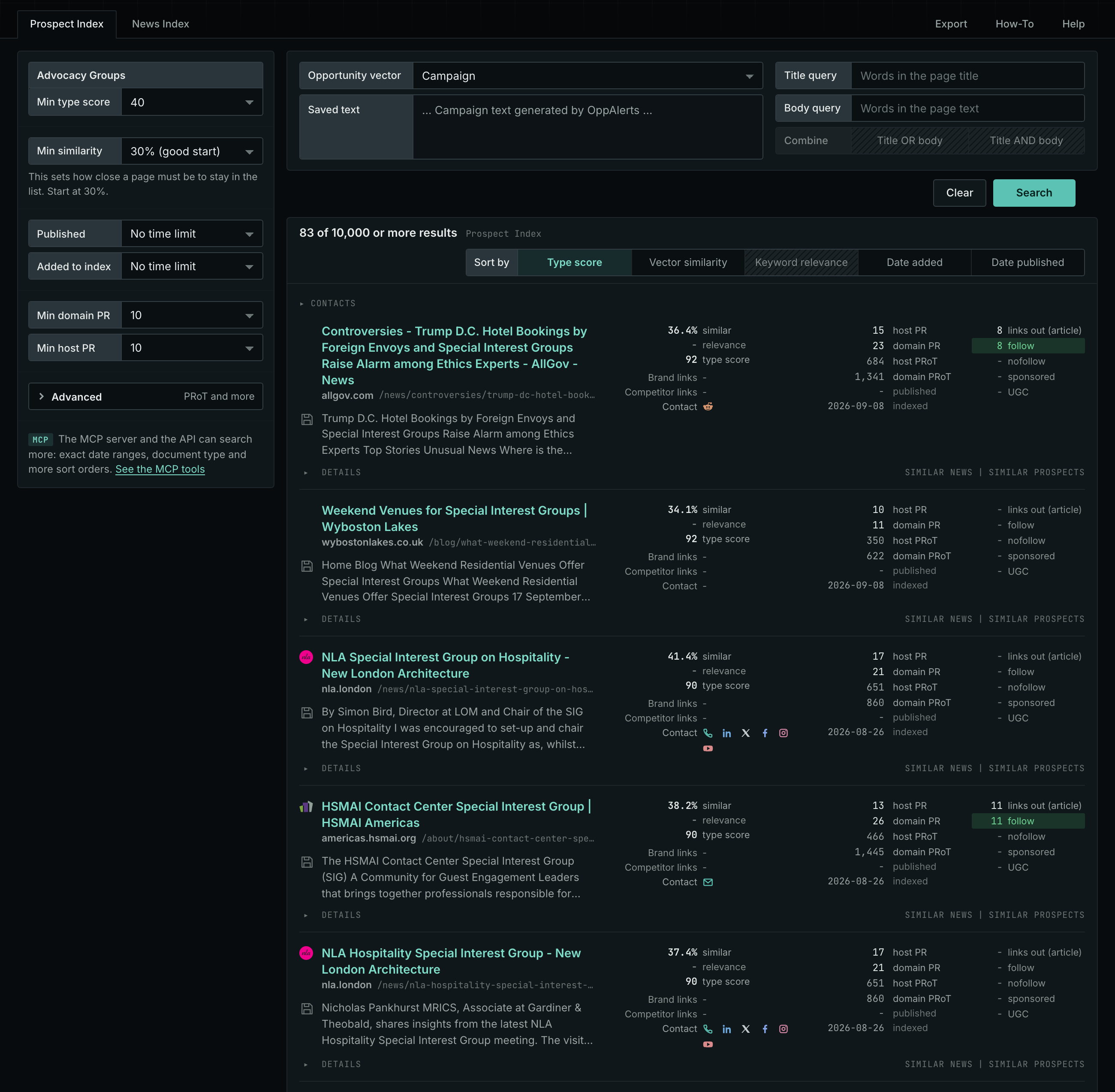
The Advocacy Groups page in the app docs shows this type in the app.
Get new pages every day
- Open your campaign in Edit Campaign, and open the Opportunities tab.
- Add an opportunity. In Search for, choose Advocacy Groups under Organizations.
- In Opportunity vector, choose Campaign.
- Open the Daily Email tab, select the checkbox, choose the hour, and click Save.
Each day, the Dashboard tab and the daily opportunities email show the pages added to the indexes in the last 24 hours. Read Daily Monitoring and Alerts for the full steps.
In MCP and the API
Two tools search this type. One request body works for both:
{
  "campaign": 3,
  "similarity_target": "campaign",
  "type_scores": [{"opportunity_type": "orgs/advocacy-groups", "type_score_min": 50}],
  "sort": "type_score"
}- MCP:
news_searchsearches the News Index.prospects_searchsearches the Prospect Index. - API:
POST https://api.oppalerts.com/v1/news/searchandPOST https://api.oppalerts.com/v1/prospects/search, with the same JSON body.
In type_scores, type_score_min sets the minimum type score, from 1 to 100. Sorting by type_score puts the highest type score first. To keep only the newest pages, add published_from or indexed_from with a date in YYYY-MM-DD format. The MCP pages list every parameter and include the full example response.
To connect your AI agent or to send API requests, read Use OppAlerts in Your AI Agent, Create an API Token, and Your First API Call.
How to judge the results
A high type score indicates that a page matches this type. It does not tell you whether the page is a good fit for you. Check these points before you act:
- Read the position of the group. Check that its goals match your values. A mention by a group that your customers dislike can do more harm than good.
- Check how the group works with companies. Look for a partner page, a corporate membership, or a sponsor list. Some groups take no money from companies.
- Check that the group is active. Look at the date of the latest news, campaign, or event.
- Check the reach. Look at the domain PR and host PR in the row, and the supporter base size reported on the page.
- Read the rules for statements. A group may require approval before you name it in your own material.
- Find out who runs the group. Look for a staff page and a contact, so you write to a person.