Documentation / Opportunity Types / How to Find Newsletters in Your Market
How to Find Newsletters in Your Market
Find the email newsletters that your buyers read, and the pages that explain how to be featured in or sponsor one.
What this type finds
This type finds newsletters and their associated pages. It groups several kinds of pages.
- Newsletter home pages and sign-up pages. The page where a reader joins a daily, weekly, or monthly email.
- Newsletter archives. Past issues on the web. They show what the newsletter writes about and how often.
- Newsletter directories and best-of lists. Pages that list newsletters in a field.
- Sponsorship and advertising pages. Pages with a media kit, the rates, audience information, and available dates for a placement.
- Submission and partnership pages. Pages where you can send your own newsletter or content for a feature.
- Email digests and bulletins. Regular emails from an organization, such as an association or a publisher.
Why it matters
A newsletter reaches readers who chose to receive it. A newsletter can give you a mention in an edition, a paid sponsorship, or a relationship with an editor who knows your market. Many newsletters also publish their issues on the web, so a mention can bring a link.
This type fits businesses that want to reach buyers directly, and agencies that need a list of paid and free placements. You can also use it for research: subscribe to newsletters in your market to read what your buyers read.
Find it in the web app
- Open Opportunity Types in the web app menu.
- Choose Media.
- Choose Newsletters.
- Read the Prospect Index tab first. It contains pages that OppAlerts fetched and offers the broader set of results. Min type score defaults to 40. Raise it to see only the pages that fit the type best.
- Read the News Index tab for news, podcasts, and video. It has fewer results and shows what is current. Few results for a type here are normal.
- Raise Min domain PR to drop the sites with little standing. Click Vector similarity in the Sort by buttons to see the pages most similar to your market first.
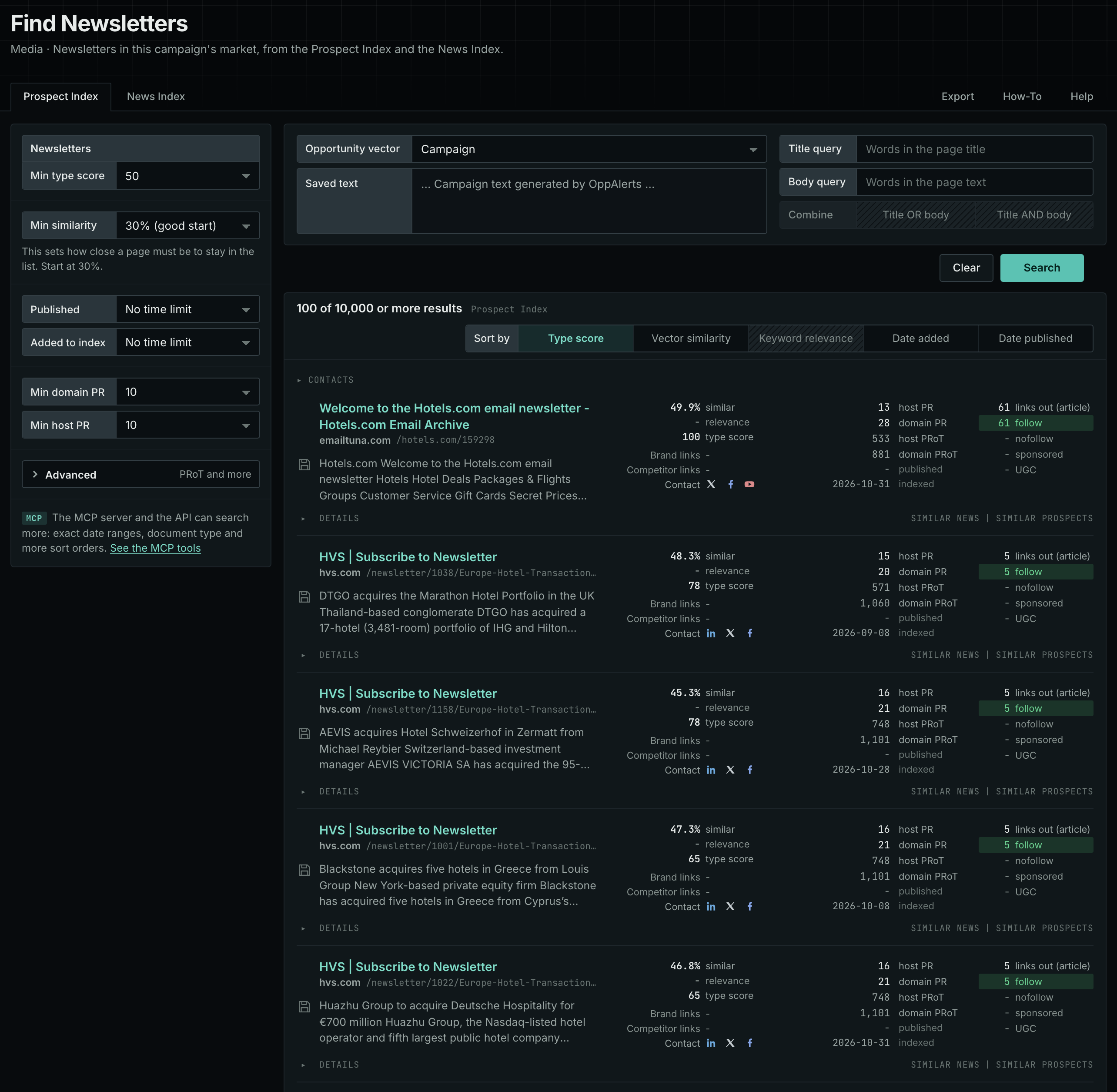
Each page's type score is based on the words in its address, title, and opening text. The score does not describe the page's subject. Your campaign supplies the subject. See Opportunity Types and Content Types.
Get new pages every day
- Open your campaign in Edit Campaign, and open the Opportunities tab.
- Add an opportunity. In Search for, choose Newsletters, under Media.
- In Opportunity vector, choose Campaign.
- Give it a Label, and click Add opportunity.
Each day, the Dashboard and the daily opportunities email show the new pages of this type. Read Daily Monitoring and Alerts to set up the daily opportunities email.
In MCP and the API
Two tools search this type. One request body works for both:
{
  "campaign": 3,
  "similarity_target": "campaign",
  "type_scores": [{"opportunity_type": "media/newsletters", "type_score_min": 50}],
  "sort": "type_score"
}- MCP:
news_searchsearches the News Index.prospects_searchsearches the Prospect Index. - API:
POST https://api.oppalerts.com/v1/news/searchandPOST https://api.oppalerts.com/v1/prospects/search, with the same JSON body.
In type_scores, type_score_min sets the minimum type score, from 1 to 100. Sorting by type_score puts the highest type score first. To keep only the newest pages, add published_from or indexed_from with a date in YYYY-MM-DD format. The MCP pages list every parameter and a full example response.
To connect your AI agent or send API requests, read Use OppAlerts in Your AI Agent, Create an API Token, and Your First API Call.
How to judge the results
- Check the archive. Look at the dates of the latest issues. A newsletter that has stopped has no audience to reach.
- Check the frequency. Daily, weekly, and monthly newsletters work in different ways.
- Check the topics. Read two or three issues. Do they match your buyers?
- Treat audience numbers as claims. A page can state a number of subscribers or an open rate. These numbers come from the seller. Ask for proof before you pay.
- Check the cost. A sponsorship page can list rates. Compare the price with the audience before you reply.
- Separate paid from earned. A sponsored item is labeled. An editorial mention is not. Know which one you are asking for.