Documentation / Content Types / How to Find Best Practices and Guides in Your Market
How to Find Best Practices and Guides in Your Market
Find the guides that define how a market works, and the experts and publishers that write them.
What this type finds
This type finds long pages that tell a reader how to do something well. It groups these kinds of pages together:
- Best-practice pages. Recommended ways to do a task, and the mistakes to avoid.
- Complete and ultimate guides. One long page on one subject, from the first step to the last.
- Beginner guides and getting-started guides. Pages for a person who is new to the subject.
- Implementation guides. Step-by-step pages on using a product, a standard, or a method.
- User guides and developer guides. Reference pages for a product or a platform.
- Field guides and resource hubs. Pages that collect the guidance of a field in one place.
- Standards and guidelines pages. Pages that state what an industry accepts as correct.
This type is different from the how-to type. A how-to page teaches one task. A guide of this type covers a subject and often recommends practices to follow.
Why it matters
This type is for research. When you enter an unfamiliar market, the guides show you what the market treats as the right way to work. You learn the terms, the steps, the standards, and the common mistakes in a short time.
It also finds experts. A company or a person that writes the definitive guide to a field is a publisher that the field trusts. The sites that link to those guides are the same sites that you may need later. Note who wrote each guide.
Find it in the web app
- Open Content in the web app menu.
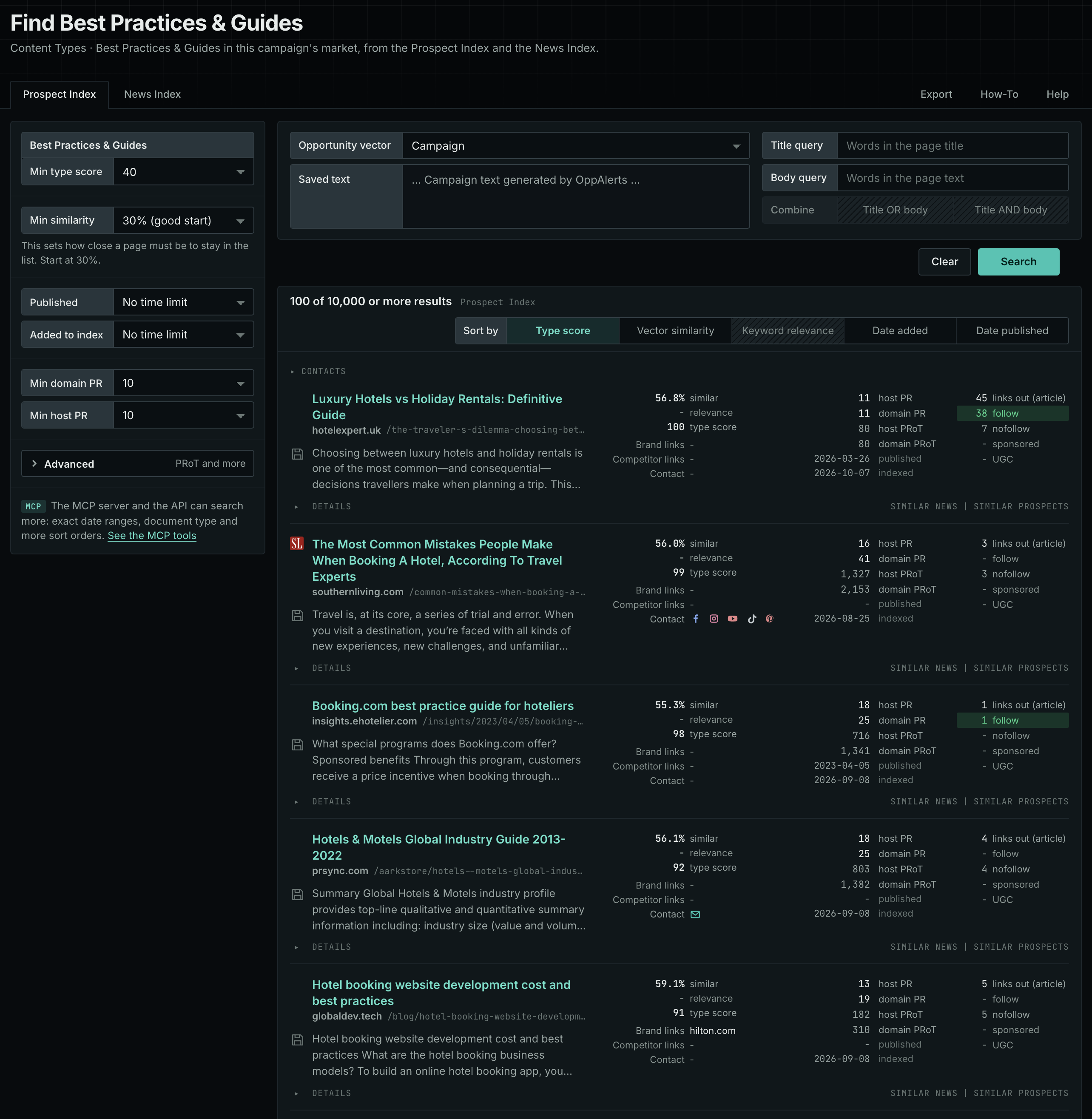
- Under Content Types, choose Best Practices & Guides.
- Start with the Prospect Index tab. It shows pages of this type from the OppAlerts index, with the closest semantic matches to your campaign first. To filter by date, use Added to index. Most pages on this tab have no published date, so using Published filters them out.
- Open the News Index tab. It shows what news sources, podcasts, and videos publish now.
- Read the first ten results of each tab. Note the subjects that have many guides, and the subjects that have none.
Min type score starts at 40, and Min similarity starts at 30%. Raise Min domain PR if the list includes sites that nobody in your market knows.
See the new pages
The Search for menu on the Opportunities tab of Edit Campaign lists the brand searches and the opportunity types. To see new pages of this content type, open Content Types again and set Added to index to Last day. The tab then shows only pages added to the index in the last day.
For details about the daily opportunities email and the saved opportunities it uses, read Daily Monitoring and Alerts.
In MCP and the API
Two tools search this type. One request body works for both:
{
  "campaign": 3,
  "similarity_target": "campaign",
  "type_scores": [{"content_type": "best-practices-and-guides", "type_score_min": 50}],
  "sort": "type_score"
}- MCP:
news_searchsearches the News Index.prospects_searchsearches the Prospect Index. - API:
POST https://api.oppalerts.com/v1/news/searchandPOST https://api.oppalerts.com/v1/prospects/search, with the same JSON body.
In type_scores, type_score_min sets the minimum type score, from 1 to 100. Sorting by type_score puts the highest type score first. To keep only the newest pages, add published_from or indexed_from, with a date in YYYY-MM-DD format. The MCP pages list every parameter and include the full example response.
To connect your AI agent or to send API requests, read Use OppAlerts in Your AI Agent, Create an API Token, and Your First API Call.
How to judge the results
- Check the date. A best practice from five years ago can be wrong now. Look for an update date.
- Check the author. A guide with a named expert and a stated method is worth more than an anonymous page.
- Check who it is for. A guide for beginners and a guide for experts address different needs.
- Check if it is a sales page. Some guides exist to sell a product. Read what the guide recommends, and what it leaves out.
- Look for the gap. If every guide on a subject is old or short, a new guide can fill the gap.
- Check the depth. Count the steps, the examples, and the sources. Plan to match the best guide, then add what it lacks.