Documentation / Opportunity Types / How to Find Comparison and Alternatives Pages
How to Find Comparison and Alternatives Pages
Find pages that compare products and list alternatives in your market, including pages that could list your business.
What this type finds
The Comparison Pages type finds pages that compare products side by side. It includes several kinds of pages:
- Head-to-head pages and versus pages that compare two products.
- Alternatives lists, such as the best alternatives to a known product.
- Comparison charts and tables with features and prices.
- Side-by-side comparisons with pros and cons.
- Pages that answer which of two products is better.
- Lists of competitors and of similar tools or products.
- Software and tool comparison sites, which compare many products in one place.
The type identifies the page's format rather than its subject. Your campaign determines which subject comes first.
Why it matters
A person who reads a comparison page is close to a choice. If your business is on the page, you reach that person at the right time. If a competitor is on the page and you are not, you lose that chance. The page can also link to your site.
It is also worth building a relationship with the publisher of a comparison page. A publisher who compares products in your market can add you, update your entry, or review your product. The type fits a business that has real competitors and a product that can hold up in a fair comparison.
Find it in the web app
- Open Opportunity Types in the web app menu.
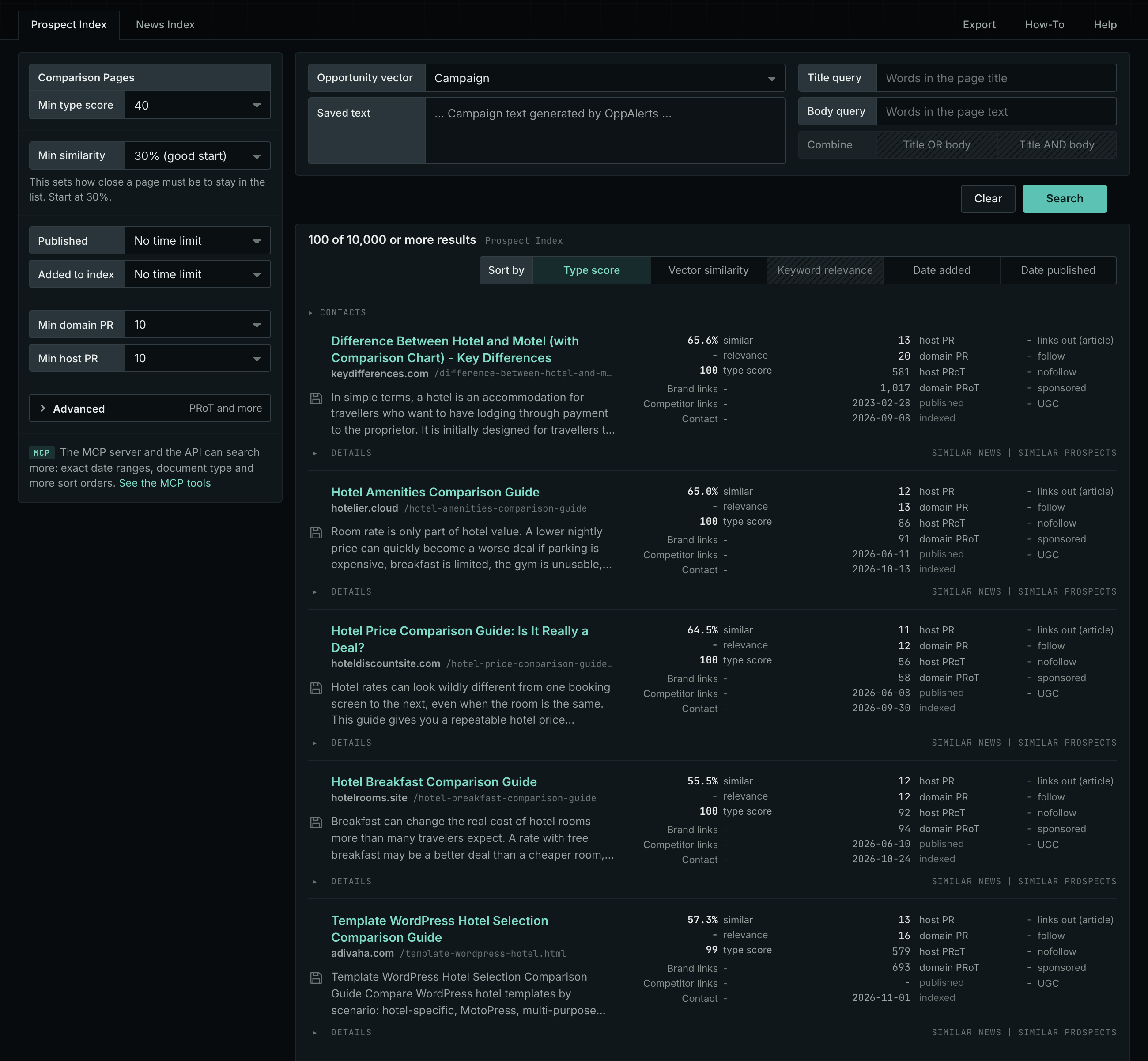
- Choose Commerce, then choose Comparison Pages.
- Read the Prospect Index tab first. It contains pages from all dates. Min type score starts at 40. Raise it to see only the pages that match this type most closely.
- Click Vector similarity in Sort by to put the pages most relevant to your market first.
- Open the pages that name your competitors. Note which ones list your business and which ones do not.
- Read the News Index tab for current pages. Set Published to the last few weeks.
Get new pages every day
- Open your campaign in Edit Campaign, and open the Opportunities tab.
- In Search for, choose Comparison Pages in the Commerce group. In Opportunity vector, choose Campaign. Click Add opportunity.
- Open the Daily Email tab, select the checkbox, choose the hour, and click Save.
Each day, the pages added to the indexes in the last 24 hours appear on the Dashboard tab and in the daily opportunities email. See Daily Monitoring and Alerts.
In MCP and the API
Two tools search this type. One request body works for both:
{
  "campaign": 3,
  "similarity_target": "campaign",
  "type_scores": [{"opportunity_type": "commerce/comparisons-and-alternatives", "type_score_min": 50}],
  "sort": "type_score"
}- MCP:
news_searchsearches the News Index.prospects_searchsearches the Prospect Index. - API:
POST https://api.oppalerts.com/v1/news/searchandPOST https://api.oppalerts.com/v1/prospects/search, with the same JSON body.
In type_scores, type_score_min sets the minimum type score, from 1 to 100. Sorting by type_score puts the highest type score first. To keep only the newest pages, add published_from or indexed_from with a date in YYYY-MM-DD format. The MCP pages list every parameter and include the full example response.
To connect your AI agent or to send API requests, read Use OppAlerts in Your AI Agent, Create an API Token, and Your First API Call.
How to judge the results
A high type score indicates that the page matches this type. It does not tell you whether the page is a good fit for you. Check these points before you act:
- Check who wrote the page. A page by a vendor will favor its own product. An independent publisher is a better partner.
- Check the date. Outdated prices and features hurt your business if the page describes it incorrectly. Look for how to send a correction.
- Check the criteria. If your product meets the criteria of the page, ask to be added. If it does not, do not ask.
- Check how the page treats the list. Some sites charge for positions in the list. Look for a note about paid placements.
- Check the audience. A page that your buyers read is worth more than a page with many visits from other markets.