Documentation / Content Types / How to Find Academic Journals and Research Publications
How to Find Academic Journals and Research Publications
Find journals and research publications in a market and the researchers and publishers behind them.
What this type finds
This type finds pages related to research publishing. It groups several kinds of pages together:
- Journal home pages. The front page of an academic, trade, or professional journal, with its scope, its current issue, and its archive.
- Editorial board and author guideline pages. They name the editors and tell a writer how to submit a paper.
- Journal articles and scholarly articles. Single papers on a subject of your market.
- Journal lists and indexing services. Databases and directories that list the journals of a field.
- Dissertation and thesis pages. Doctoral and master's research, and the checklists, workshops, and editing services around it.
- Business and industry journals. Publications of a trade or a business sector that are less formal than a scholarly journal.
The type reads the words of a page. So some results are publications with the word journal in their name that are not research journals.
Why it matters
This type is for research. When you get a new client or enter an unfamiliar market, it quickly shows you what researchers write about that market. You see which subjects they study, which words they use, and which journals the market reads.
It also finds experts. An editorial board page names the people who judge the work of a field. A journal page names its authors. A person or a publisher that appears again and again here is worth knowing. You can read their work, cite it, or contact them.
Find it in the web app
- Open Content in the web app menu.
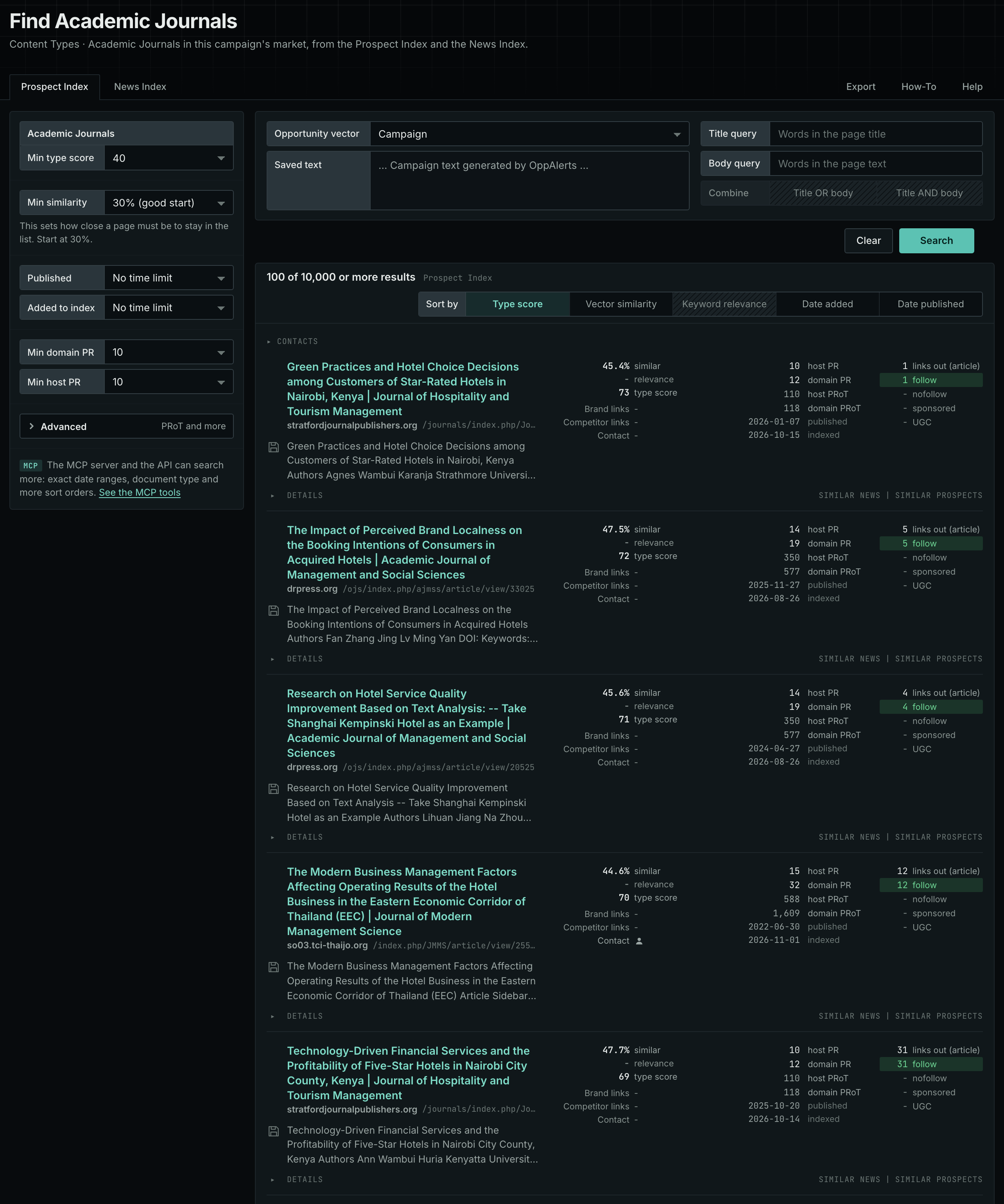
- Under Content Types, choose Academic Journals.
- Start with the Prospect Index tab. It shows pages of this type from the OppAlerts index, with the closest semantic matches to your campaign first. To filter by date, use Added to index. Most pages on this tab have no published date, so using Published filters them out.
- Open the News Index tab. It shows what news sources, podcasts, and videos publish now.
- Read the first ten results of each tab. Note the journal names that appear more than once, and the names of the editors and authors.
Min type score starts at 40, and Min similarity starts at 30%. Raise Min domain PR if the list includes sites that nobody in your market knows.
See the new pages
The Search for menu on the Opportunities tab of Edit Campaign lists the brand searches and the opportunity types. To see new pages of this content type, open Content Types again and set Added to index to Last day. The tab then shows only pages added to the index in the last day.
For details about the daily opportunities email and the saved opportunities it uses, read Daily Monitoring and Alerts.
In MCP and the API
Two tools search this type. One request body works for both:
{
  "campaign": 3,
  "similarity_target": "campaign",
  "type_scores": [{"content_type": "academic-journals", "type_score_min": 50}],
  "sort": "type_score"
}- MCP:
news_searchsearches the News Index.prospects_searchsearches the Prospect Index. - API:
POST https://api.oppalerts.com/v1/news/searchandPOST https://api.oppalerts.com/v1/prospects/search, with the same JSON body.
In type_scores, type_score_min sets the minimum type score, from 1 to 100. Sorting by type_score puts the highest type score first. To keep only the newest pages, add published_from or indexed_from, with a date in YYYY-MM-DD format. The MCP pages list every parameter and include the full example response.
To connect your AI agent or to send API requests, read Use OppAlerts in Your AI Agent, Create an API Token, and Your First API Call.
How to judge the results
- Check that it is a research journal. Look for a stated scope, an editorial board, and author guidelines. A page with the word journal in the title can be a news site or a diary.
- Check the date. Read the date of the current issue. A journal with no new issue for years does not show what the market studies now.
- Check access. Some journals show only the abstract. Find out if you can read the full paper before you plan to use it.
- Check the publisher. Look for a university, a society, or a known publisher. Be careful with a journal that you cannot find outside its own site.
- Match the subject to your market. A journal covering a broad field can have only a few papers relevant to you. Read the titles first.
- Check the cost. Author guidelines can state fees. Read them before you plan to submit a paper.