Documentation / Opportunity Types / How to Find News Sites and Publishers
How to Find News Sites and Publishers
Find the publishers and news sites that cover your industry, and the pages that tell you how to approach them.
What this type finds
This type finds news sites and publishers, and the pages on those sites that explain how they work.
- News sites and online publications. Sites that publish news and analysis, general or for one market.
- Trade and industry publications. Publishers whose readers work in one industry.
- Media brands and news organizations. The companies that run several outlets.
- Media directories. Pages that list the outlets that cover an industry.
- Pitch pages. Pages where a publisher asks for story ideas, tips, or press releases.
- Editorial policy pages. Pages that say how the editors choose and check what they publish.
- Media kits and advertising pages. Pages that give audience information and say how to buy a placement or a sponsorship.
- Editorial calendars and special issues. Pages that show which subjects a publisher plans to cover and when.
Why it matters
This type shows you which publishers shape news in your market. A mention in a publication that your buyers read can give you a link, trust, and an audience.
It fits PR teams and agencies that build a media list, and business owners who want to know where news about their industry appears. The editorial calendars help you time a pitch. The advertising pages show which outlets sell placements.
Find it in the web app
- Open Opportunity Types in the web app menu.
- Choose Media.
- Choose News Sites.
- Read the Prospect Index tab first. It contains pages that OppAlerts fetched and offers the broader set of results. Min type score defaults to 40. Raise it to see only the pages that fit the type best.
- Read the News Index tab for news, podcasts, and video. It has fewer results and shows what is current. Few results for a type here are normal.
- Raise Min domain PR to drop the sites with little standing. Click Vector similarity in the Sort by buttons to see the pages most similar to your market first.
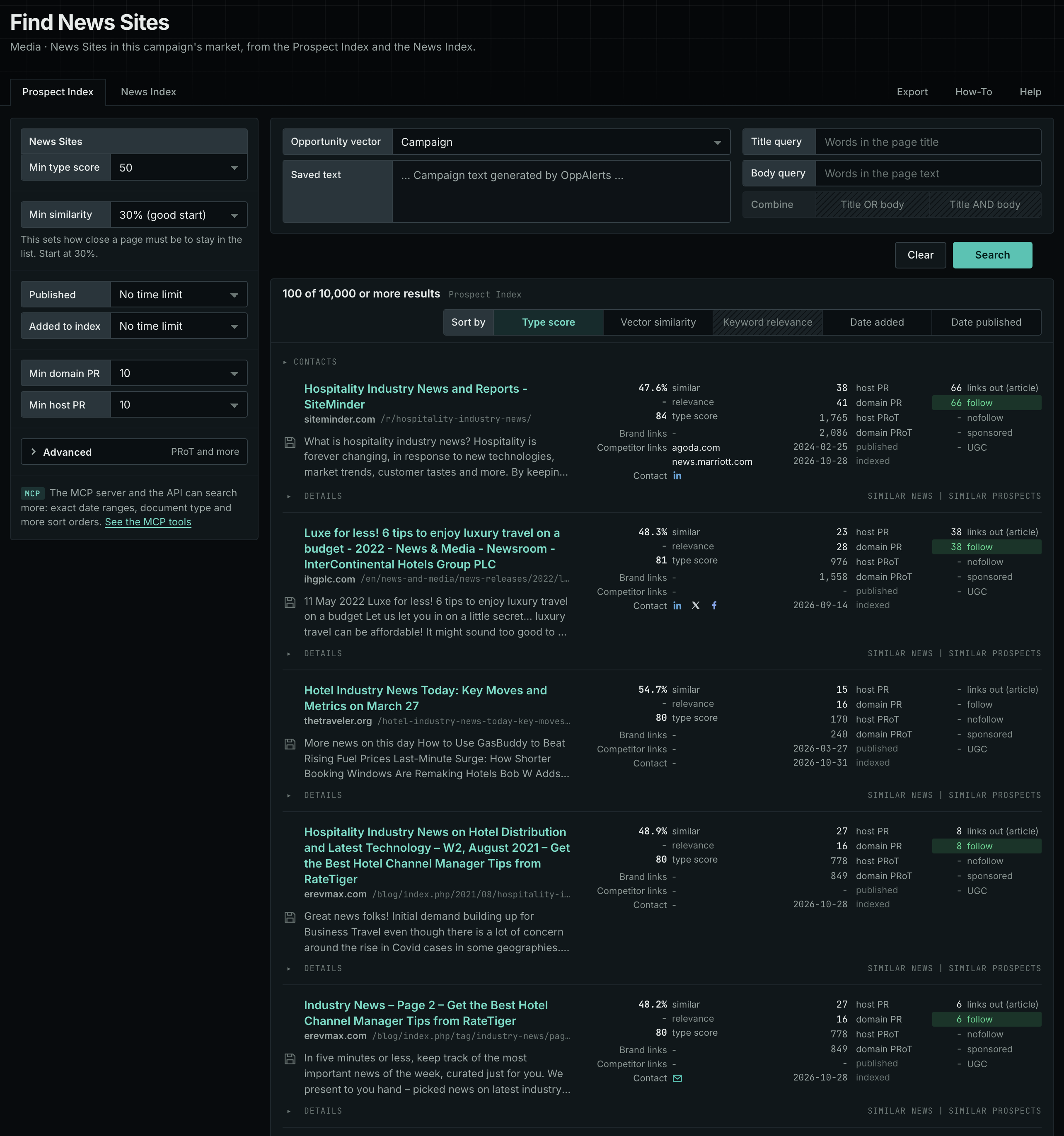
Each page's type score is based on the words in its address, title, and opening text. The score does not describe the page's subject. Your campaign supplies the subject. See Opportunity Types and Content Types.
Get new pages every day
- Open your campaign in Edit Campaign, and open the Opportunities tab.
- Add an opportunity. In Search for, choose News Sites, under Media.
- In Opportunity vector, choose Campaign.
- Give it a Label, and click Add opportunity.
Each day, the Dashboard and the daily opportunities email show the new pages of this type. Read Daily Monitoring and Alerts to set up the daily opportunities email.
In MCP and the API
Two tools search this type. One request body works for both:
{
  "campaign": 3,
  "similarity_target": "campaign",
  "type_scores": [{"opportunity_type": "media/publishers-and-news-sites", "type_score_min": 50}],
  "sort": "type_score"
}- MCP:
news_searchsearches the News Index.prospects_searchsearches the Prospect Index. - API:
POST https://api.oppalerts.com/v1/news/searchandPOST https://api.oppalerts.com/v1/prospects/search, with the same JSON body.
In type_scores, type_score_min sets the minimum type score, from 1 to 100. Sorting by type_score puts the highest type score first. To keep only the newest pages, add published_from or indexed_from with a date in YYYY-MM-DD format. The MCP pages list every parameter and a full example response.
To connect your AI agent or send API requests, read Use OppAlerts in Your AI Agent, Create an API Token, and Your First API Call.
How to judge the results
- Check the News Index tab. A publisher that wrote about your market in the last few weeks covers it now.
- Check the date. An old media kit or an old calendar can show plans that are out of date.
- Read the editorial policy. It shows whether the publisher takes pitches, how it labels sponsored items, and who decides.
- Separate earned from paid. A page that sells placements is an advertisement, not coverage. Know which one you want.
- Check the audience. A media kit provides audience information. Treat this information as the seller's claims.
- Find a person. Open Details in the result row for the contact routes. Write to an editor who covers your subject, not to a general address.