A useful content brief explains what the reader needs to know and gives the writer the material to answer it. Research tools can help you find discussions, search results, popular articles, and AI answers. Keep track of where each finding came from so you know what it tells you.
Imagine an installation problem appears in a forum thread, a popular article, and an AI answer. The thread shows a discussion. The article's engagement shows attention. The AI answer shows what that service returned. You can use all three, but they aren't three measurements of customer demand.
OppAlerts publishes this guide and is included in it. The vendor plans below come from September 2026 research.
Choose the sources your brief needs
BuzzSumo's Question Analyzer uses forums and question sources including Amazon, Reddit, and Quora. Open the discussion behind a question to understand the person's situation and whether it matches the buyers you want to reach.
BuzzSumo Content Analyzer researches content by topic, URL, or domain. Trending Feeds focuses on recent activity. Engagement can help you find formats and subjects to investigate; read the article to see how well it explains the installation problem. The researched plans range from $199 to $499 monthly on annual billing.
Semrush provides keyword research, while Frase combines topic research with content tools. Use search data to explore the language around a subject and the pages returned for it. You can also follow relevant publications, keeping the original articles and dates with your notes.
For AI research, Peec describes prompt-volume scores and intent classifications. Profound describes Prompt Volumes based on conversation research. Look at the methods and source coverage before treating an estimate as the number of people asking your exact question.
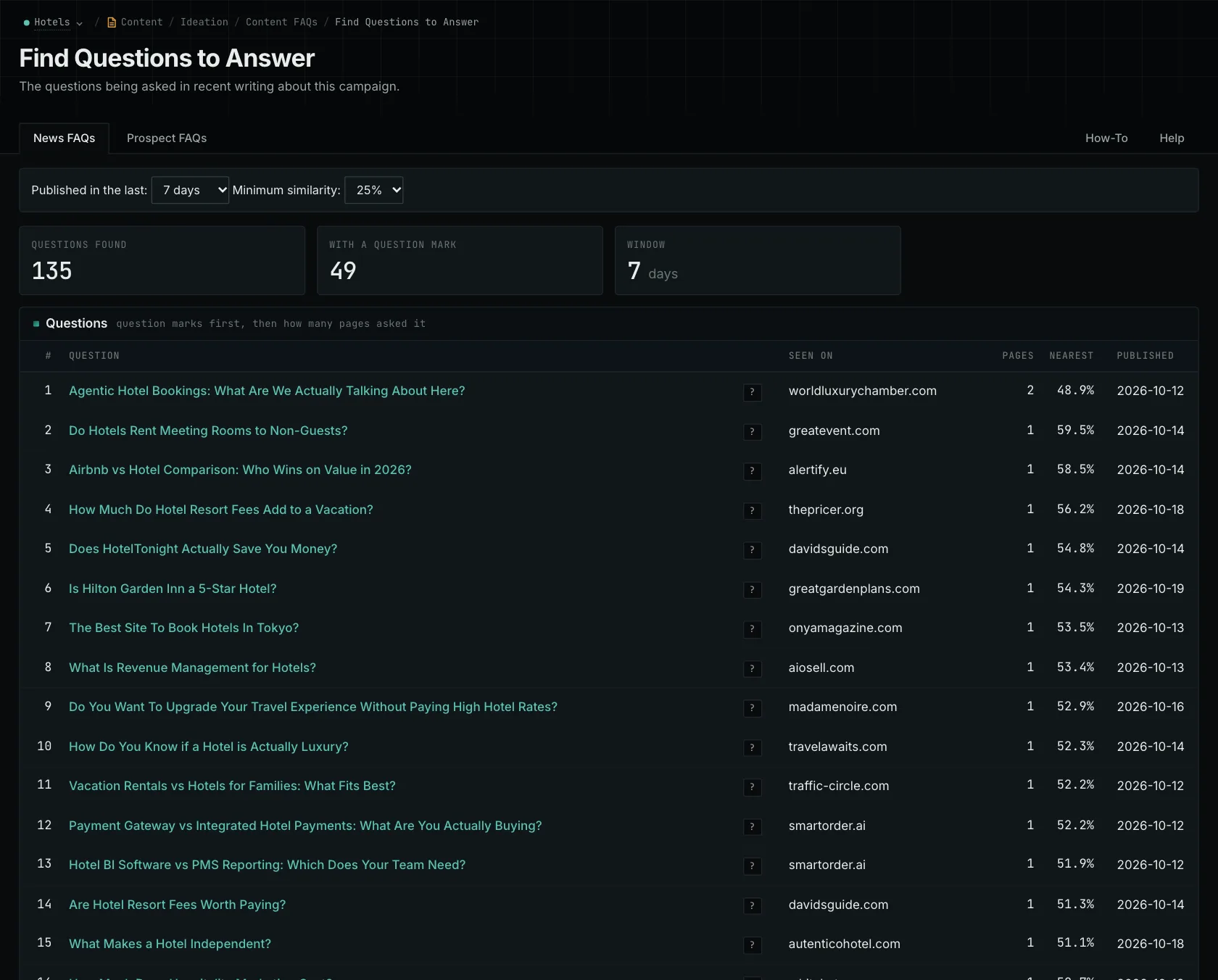
Turn a question into something to investigate
OppAlerts Content FAQs has two tabs: News FAQs and Prospect FAQs. Each shows questions used in the titles of pages in its index. Open those pages to see how publishers answer the questions and which readers they're trying to reach.
For the installation brief, read the source behind each useful question. A forum post might explain a difficulty that an AI answer barely addresses. That gives you a practical problem to research and a reason for your article to explain it more clearly.
OppAlerts campaigns store your business, brands, and competitors. You can also search news, blogs, and podcasts by words or meaning, find opportunity types, and review brand and competitor mentions. Campaign research also shows which businesses AI models recommend. The question-review guide shows how to use the findings in a brief.
Decide how much help you need after research
Frase researches and drafts, and Content Guard monitors published pages for decline. Surfer Standard, at a researched $99 monthly billed yearly, creates or optimizes 360 documents per year. Clearscope Essentials, at $129, includes 20 monthly topic explorations, 20 drafts, 50 pages, and 50 tracked prompts. Profound Agents produces briefs and drafts for review and CMS publication.
OppAlerts doesn't write the draft. Content Optimizer checks text you provide against up to three categories, one per taxonomy, and shows related phrases missing from it. Each comparison accepts up to 8,192 bytes. Use the results to review the writing alongside the facts and questions in your brief.
Finish the installation brief with the reader's problem, the evidence you've found, and what the new article will explain. That gives the writer a clear assignment. The content optimization comparison covers the tools you can use once there's a draft.
Browse all comparisons and alternatives.
See how OppAlerts fits your work.
Tell me what you are working on and what you need to find out. I can walk you through the relevant reports and explain what OppAlerts can help you do.
You can explore the demo first, or use this form to ask about a task or arrange a demonstration with me.