When an AI answer includes your business, what exactly happened? It might have named you, recommended you, or cited a page from your site. Those mean different things. To understand an AI search visibility report, you need to know which of those things it's measuring.
What appeared in the answer?
A brand mention means the answer names the business. That's all the term tells you. The answer could recommend it, describe it neutrally, or warn against it. A recommendation goes further: it presents an option as suitable for the conditions in the question. “Companies often consider X” and “X suits this requirement” both name X, but they say different things about it.
A citation points to a source referenced in the answer. That source doesn't have to belong to the business being discussed. An assistant could recommend your product and cite an independent review. So you need to keep track of the brand appearance and the cited domain separately. The citation guide explains what that means for the research you do next.
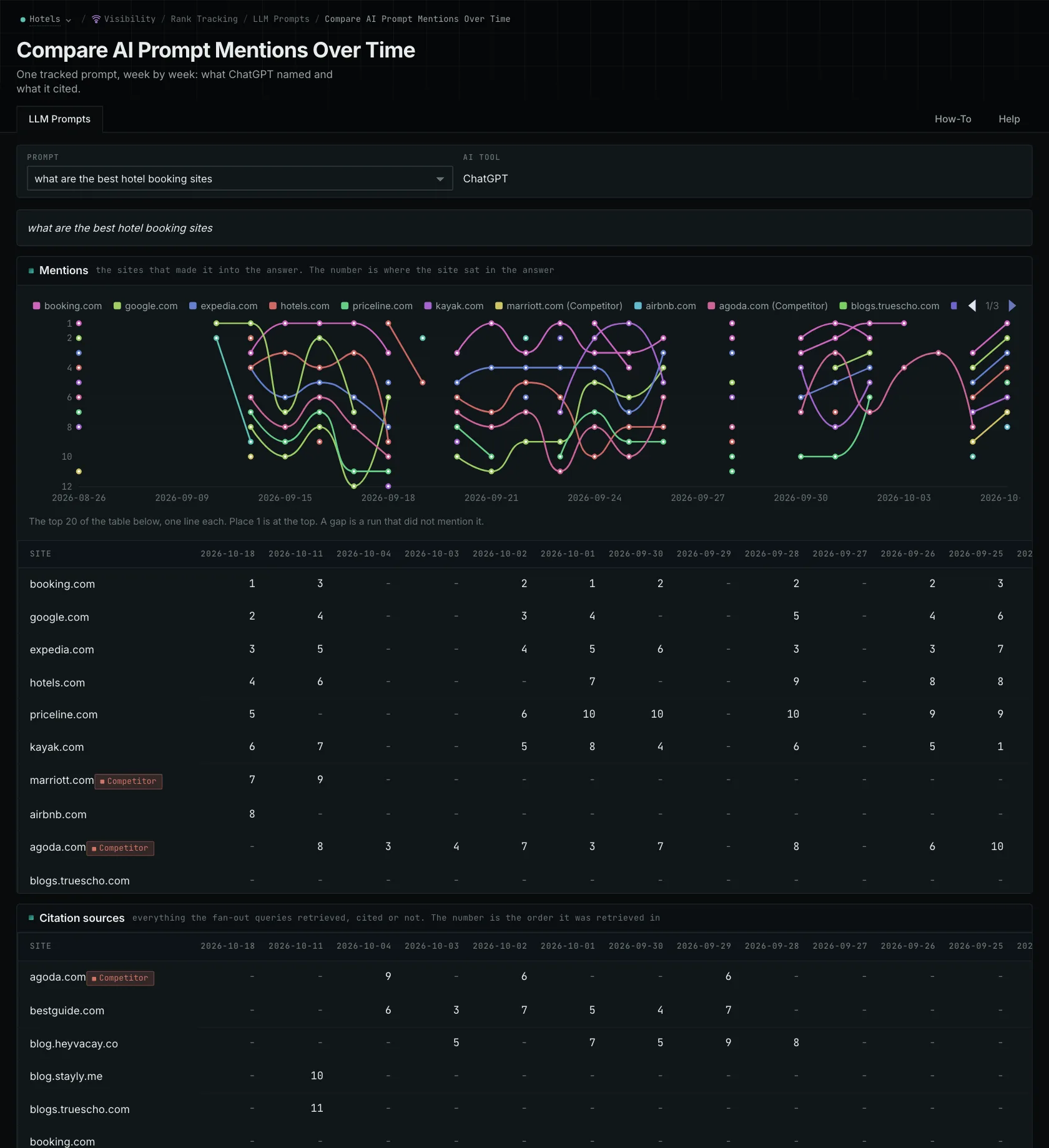
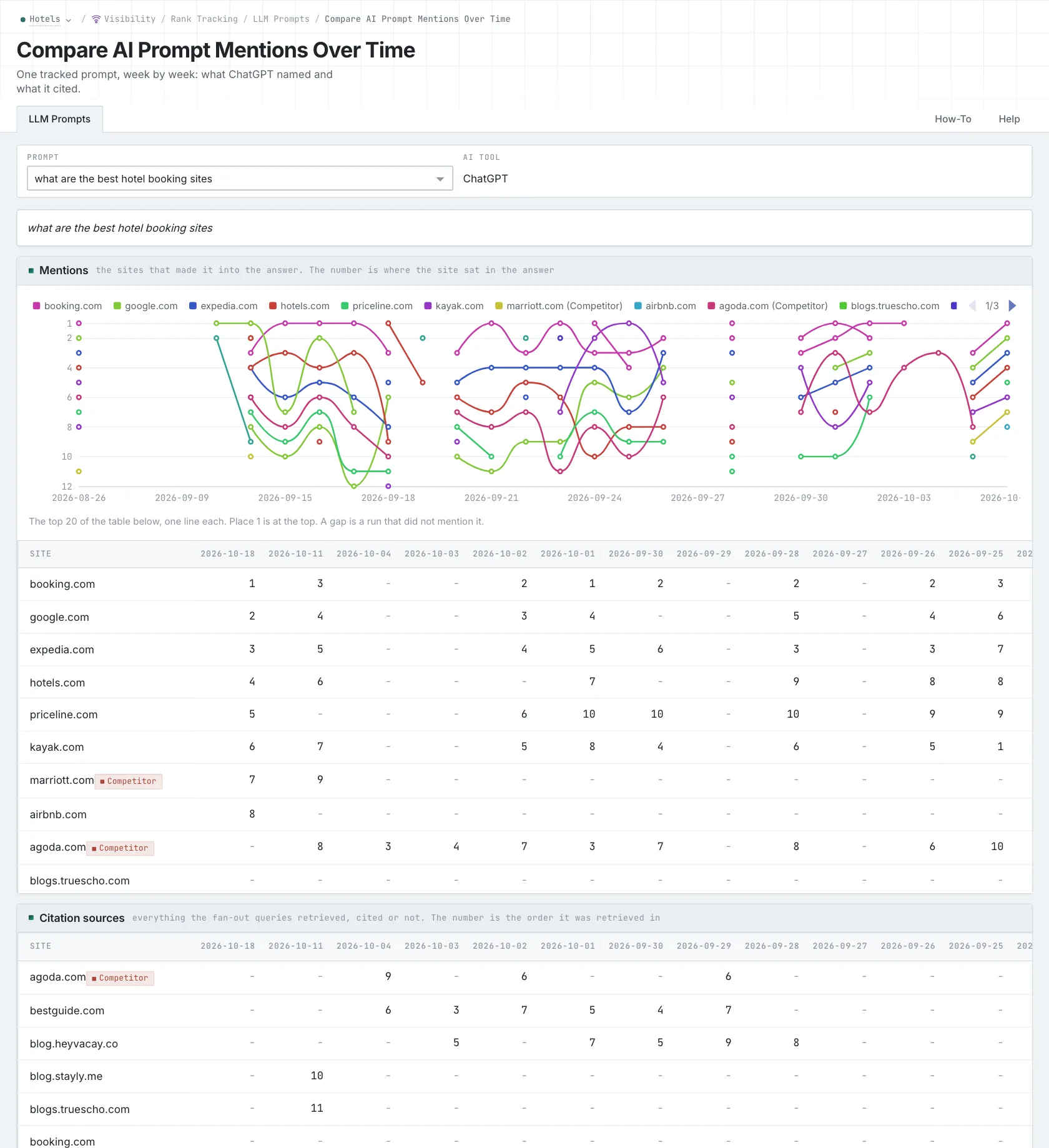
A retrieved source is something the service obtained while putting its answer together. It might never appear as a citation. Some services report what they read separately from what they show you. A suggested fanout query is a follow-up search the assistant says it would run. You can use it as a research lead, but the suggestion doesn't prove the search happened. An observed query needs a record from a particular execution showing that it actually ran.
What question did you measure?
A prompt is the question you send to the assistant. OppAlerts sends tracked prompts exactly as you write them. Change the wording, and you change what you're investigating. If a buyer has requirements that affect their decision, put those requirements in the prompt itself.
Imagine a procurement team that needs regional permissions and a sole trader who doesn't. You would expect them to consider different products. Their questions can produce different recommendations because they have different requirements. Neither answer has to be universally right or wrong.
A sample is the observation or set of observations behind a report. Depending on the supplier, that might be one collected answer, several runs, or a combined result. Answers can vary, so check how many runs were collected and over what period. One run tells you what came back that one time.
Visibility describes whether and how a brand appears. There's no standard unit for it. One report might count mentions, another citations, and another your share against selected competitors. Before you compare the numbers, find out what each one counts. The visibility guide walks through what you can learn from those measurements.
Understand the services and the names for the work
A large language model, or LLM, is the model behind an assistant's answers. But the model is only part of the service you use. ChatGPT, for example, can combine models with retrieval and formatting. What you learn about a model doesn't automatically describe everything the product does.
Google's AI Overview is a generated summary within search results. AI Mode is a separate conversational search experience. OppAlerts can collect an Overview with Google keyword results and an AI Mode answer through prompt tracking. You need to observe the two experiences separately.
AEO means answer engine optimization, and GEO means generative engine optimization. Both broadly describe work on how brands appear in generated answers. People use them in heavily overlapping ways, so the acronym alone doesn't tell you the method. You'll also hear LLM SEO and LLMO for similar work. AI SEO needs particular care: someone might mean using AI to do conventional SEO, or they might mean working on how a business appears in AI answers.
AI rank tracking is a common name for repeatedly observing these answers, even though many answers don't contain an ordered list. When there is a list, its positions belong to that collected answer. They don't establish where a business appears in every response. So be specific about what you need to track: repeated brand appearances, cited sources, or recommendations under particular conditions.
See how OppAlerts fits your work.
Tell me what you are working on and what you need to find out. I can walk you through the relevant reports and explain what OppAlerts can help you do.
You can explore the demo first, or use this form to ask about a task or arrange a demonstration with me.