Sometimes you need to find a specific name or phrase. Other times, you want writing about the same idea, however the author described it. Keyword matching and vector similarity help with those different tasks. Understanding the difference makes the results easier to use.
Imagine you sell restaurant scheduling software and want articles about the staffing problem it solves. A journalist might write about “staff rotas” or Friday-night shortages. You can see the connection, but a search requiring “restaurant scheduling software” can't match a phrase that isn't there.
Use keyword matching to check the words
Keyword matching looks for the terms and matching conditions you request in the indexed text. Put a product name in quotes, and you're requiring that phrase in the document. That's useful when you're looking for a brand mention, an error code, or a term that needs to appear.
For that task, a page about a similar product shouldn't qualify just because the subjects are related. You need the exact wording. But when you're researching the restaurant staffing problem, that same requirement can exclude an article that uses different words.
Use vectors to compare meaning
An embedding model converts text into a list of numbers called a vector. OppAlerts uses vectors with 768 numbers. Comparing those lists gives you a numerical measure of similarity. What the model has learned lets it relate passages even when they use different vocabulary. Google's embeddings overview explains the general approach.
A description of restaurant staffing could find material about missed shifts without requiring your exact product-category phrase. It could also find hospital shifts or retail staffing. Those are hypothetical examples, not measured search results. They show why you still need to examine how something is related and who it's relevant to.
For your restaurant campaign, read whether the publication addresses restaurant managers and covers the conditions you care about. Similarity lets you search across a wider range of language. You still decide whether the result is relevant.
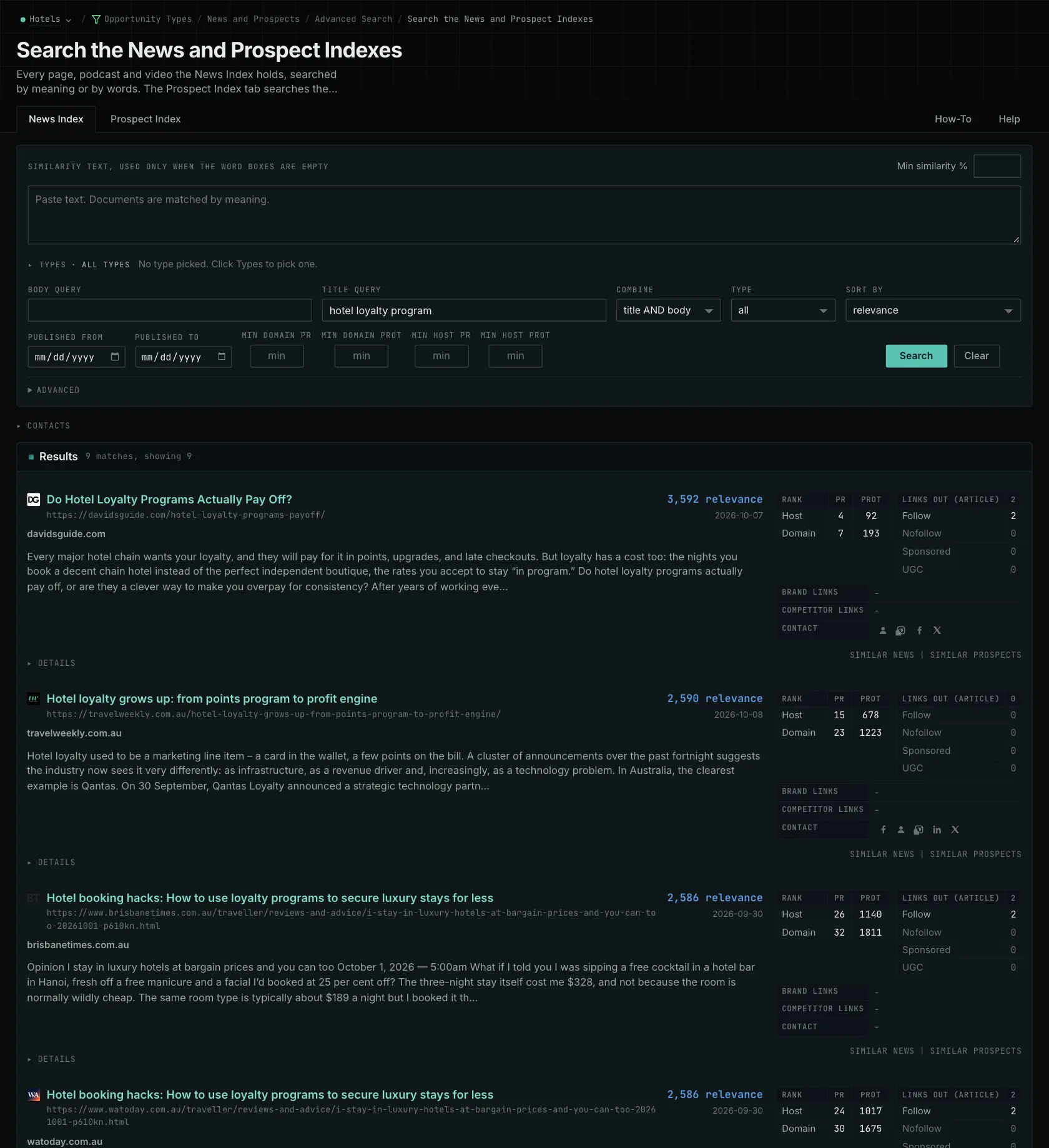
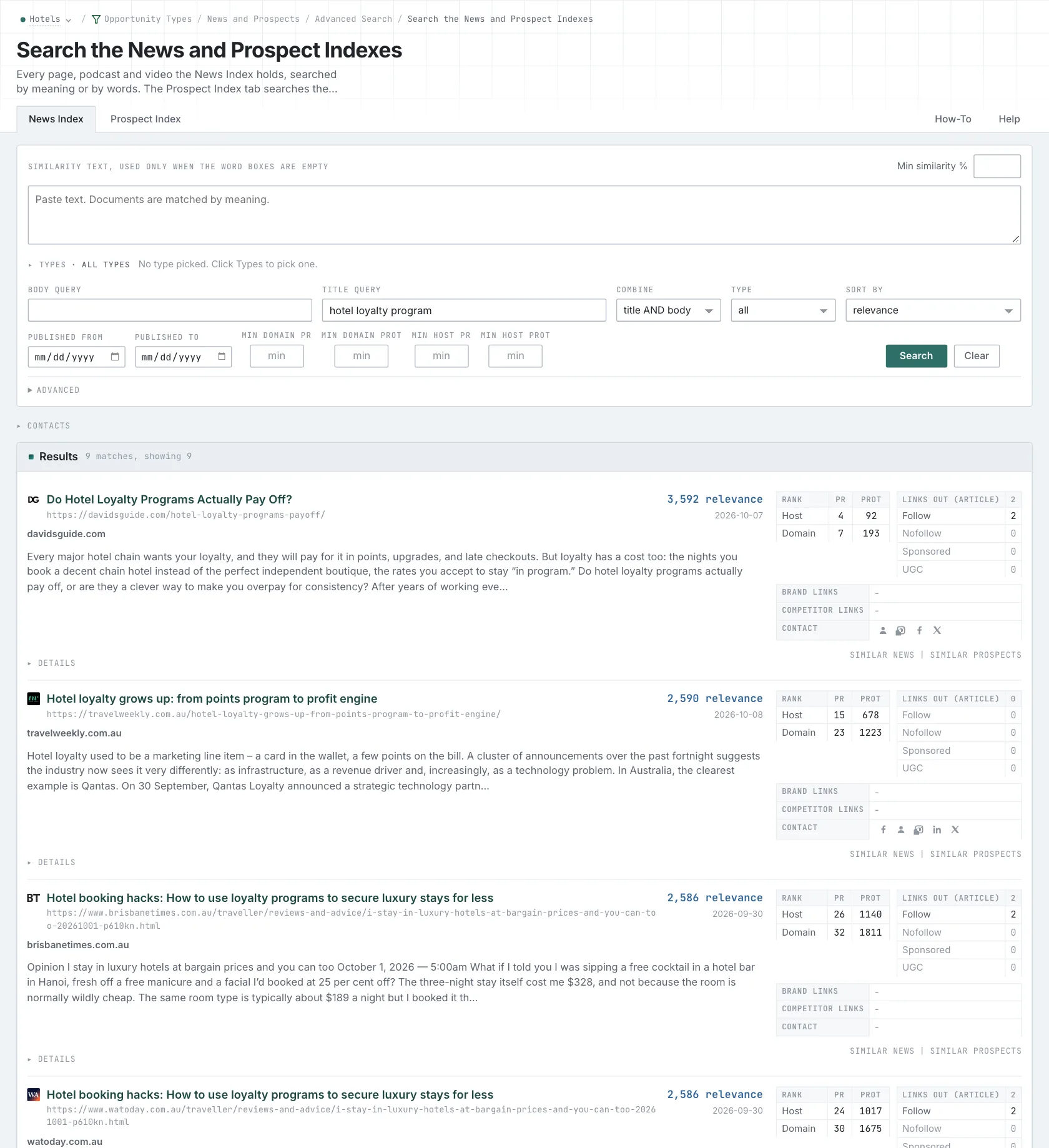
Choose the method for the question you're asking
To find mentions of a product, start with its name. To research a market, describe the customer's problem. That can help you find language you hadn't thought to search for. A relevant resource page could use unfamiliar terms, while checking for a required phrase means looking for the literal wording.
The same applies when you edit. Comparing a draft with a subject measures their relationship. Checking for a term tells you whether those words appear. A high similarity score doesn't establish keyword coverage, and adding terms doesn't reliably move the score.
You also need compatible embeddings from the same model on both sides of the comparison. Two models could each return 768 numbers, but those coordinates wouldn't necessarily have comparable meanings. The same number of values isn't enough.
Read beyond the score
Similarity doesn't establish truth or writing quality. A passage can be wrong and still closely resemble its subject. A short, focused piece can also score closer than a thorough guide covering several related topics. No search engine or assistant takes part in producing this number, so it doesn't predict how one will rank or cite the page.
You can use both methods in one investigation. Describe the staffing problem to find related restaurant coverage. Then check exact details, such as a competitor name, contribution instructions, or a standard mentioned on the page. Each check answers a particular part of the research.
The guides to semantic content editing and news research show how to use these comparisons. The content-scoring methodology explains the numerical calculation.
See how OppAlerts fits your work.
Tell me what you are working on and what you need to find out. I can walk you through the relevant reports and explain what OppAlerts can help you do.
You can explore the demo first, or use this form to ask about a task or arrange a demonstration with me.