| Research overview | The conclusions and the key data, shortened |
|---|---|
| Blog post with the full details | We Now Know the #1 Ranking Factor for AI and LLMs, The Data |
| Shorter post | We Now Know the #1 Ranking Factor for AI and LLMs |
What the research found
We have spent years trying to understand why ChatGPT and Gemini recommend one brand over another. For this study, I compared recommendations from 16 AI models and the ChatGPT web interface across 100 industries with the pages that link to and mention those brands. In every AI channel tested, the number of backlinks from contextually relevant pages had the strongest correlation with AI score. I also found that 24.4% of the domains the models recommended were not registered.
Findings you can quote
- Backlinks from contextually relevant pages had the strongest correlation with AI score in all 17 AI channels tested.
- For GPT-6 Astra, the median brand at AI rank 1 has 2,124 backlinks from contextually relevant pages. At AI rank 50 it is 25.
- The gap depends on the industry. The top 10 in CRM software have a median of 17,327.5 relevant backlinks. The top 10 in cosmetic dentistry have 5.5.
- Of the top 10 brands that have PageRank records, 94% already had PageRank in July 2017.
- For a typical brand, one more backlink lines up with about as much AI score as 10 more unlinked mentions.
- Of 117,453 different domains in the AI answers, 28,674 were not registered. GPT-5 Nano recommended an unregistered domain in 11.12% of its recommendations. GPT-6 Astra did so in 0.28%.
Quotes from Ben Wills
These quotes are from the published research posts.
“With SEO, we never had anything concrete. With LLMs, now we do.”
“A backlink report that only counts links leaves out the part that had the strongest relationship with AI rankings in this research.”
“[T]he brands AI recommends first have been well established on the web for a long time. Their advantage didn’t suddenly appear when ChatGPT launched.”
Story angles by audience
AI search visibility
Counting links alone leaves out the part with the strongest relationship to AI score: how relevant the linking pages are to the industry. For GPT-6 Astra, the relationship was positive in all 100 industries, ranging from 0.20 for personal loan and fintech lenders to 0.87 for ERP software.
SEO
Total backlinks (0.55) and the PageRank of the brand’s site (0.54) correlated almost as strongly as relevant backlinks (0.57) for GPT-6 Astra. And these brands were already established. The groups of recommended brands were in the same PageRank order nine years ago.
Public relations
The same relevance pattern appears on pages that mention a brand without linking to it. For GPT-6 Astra, unlinked mention counts correlated with AI score at 0.41. In four industries, including streaming video services and residential real estate brokerages, those mentions were more focused on the industry than links in all 24 comparisons.
Brand monitoring
Matching a brand name is more complicated than it sounds. “Four Seasons” can mean the hotels, Vivaldi, or a team’s last four seasons. In this data, fourseasons.com has 3,284 backlinks and only 94 unlinked mentions. That mention count does not represent the full picture of how often people discuss the hotels.
Reputation monitoring
The models also recommended websites that do not exist. In newer models, 21% to 38% of these hallucinated domains were close to a real domain in the same industry: an added hyphen, as in mrs-meyers.com, or a missing letter, as in sharppring.com for sharpspring.com. Eleven of the 17 channels recommended tour-edge.com, which was unregistered. The golf brand’s actual domain is touredge.com.
Competitive analysis
You can measure the backlink gap in your own industry, but the counts do not determine the exact ranking. In GPT-6 Astra’s hotel list, The Breakers and The Plaza are in the top 10 with 114 and 93 backlinks in the data. The correlation for hotels is 0.50.
Link building
Use relevance to decide which opportunities to prioritize. Once I accounted for total backlinks, the mix of opportunity types, such as guest posts and events, added almost nothing. The small exception was listicle inclusion: a page that lists the brand among its recommended options (0.13 for GPT-6). If a relevant page already mentions your brand, asking for a link is a straightforward place to start.
Content marketing
A backlink profile can show you what a brand is known for. Marriott’s includes Corporate Events and Business Travel alongside Hotels. For Castle Hill Inn, the top categories are Rhode Island, Providence, New England and Maine.
Charts
These charts come from the data post. Each has a dark and a light version. Credit: OppAlerts, October 2026.
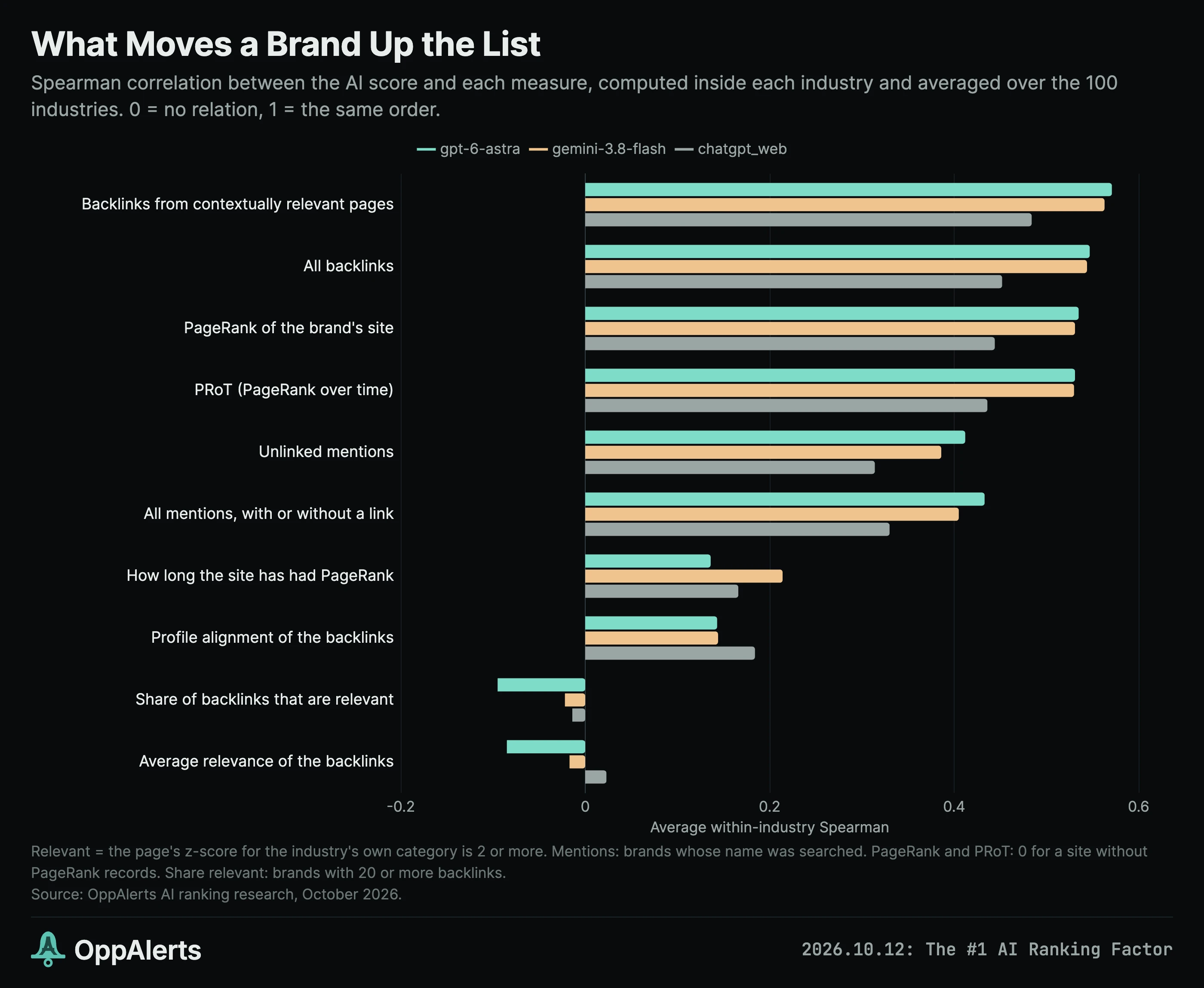
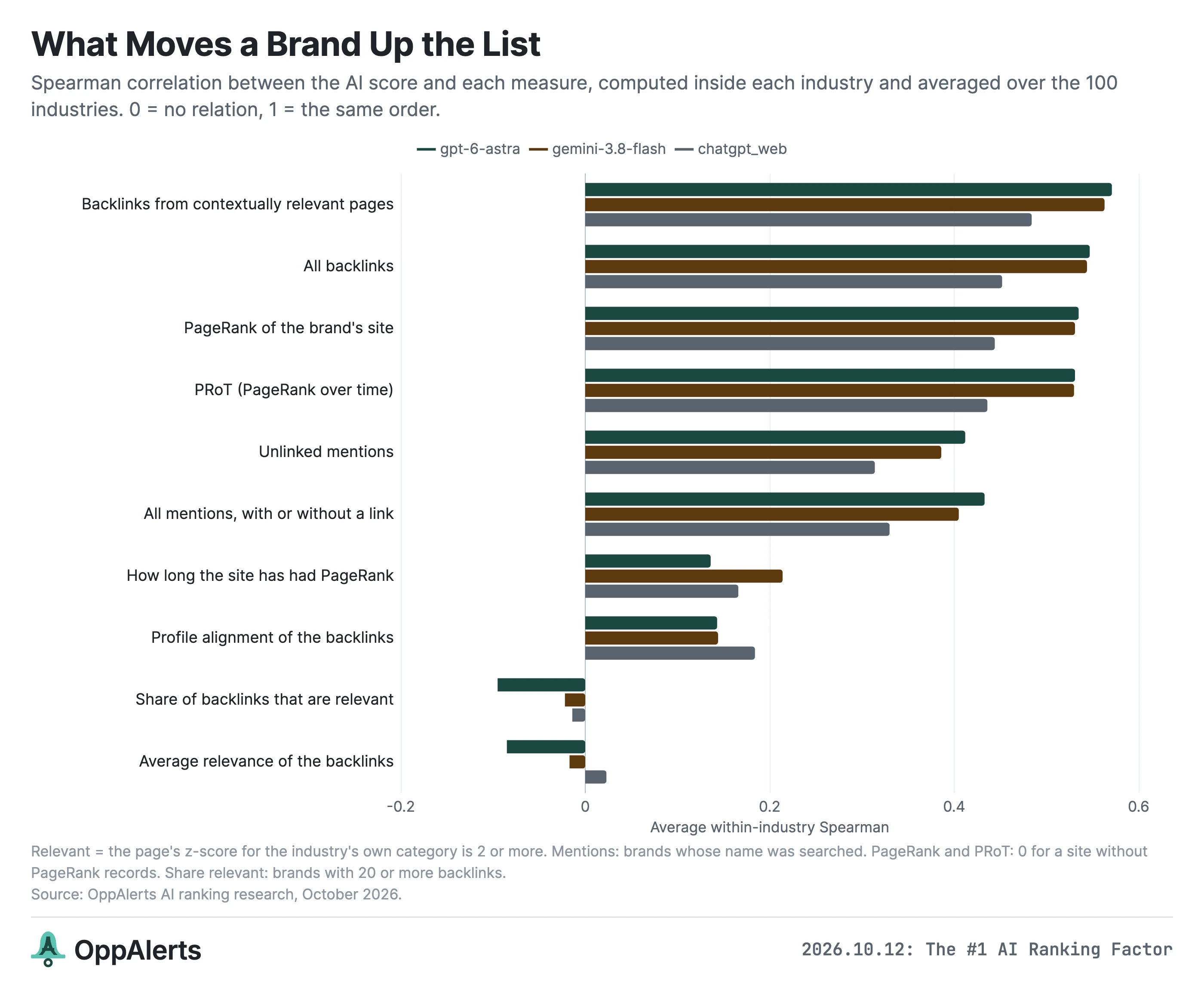
Of the measures tested, relevant link counts have the strongest correlation with AI scores.
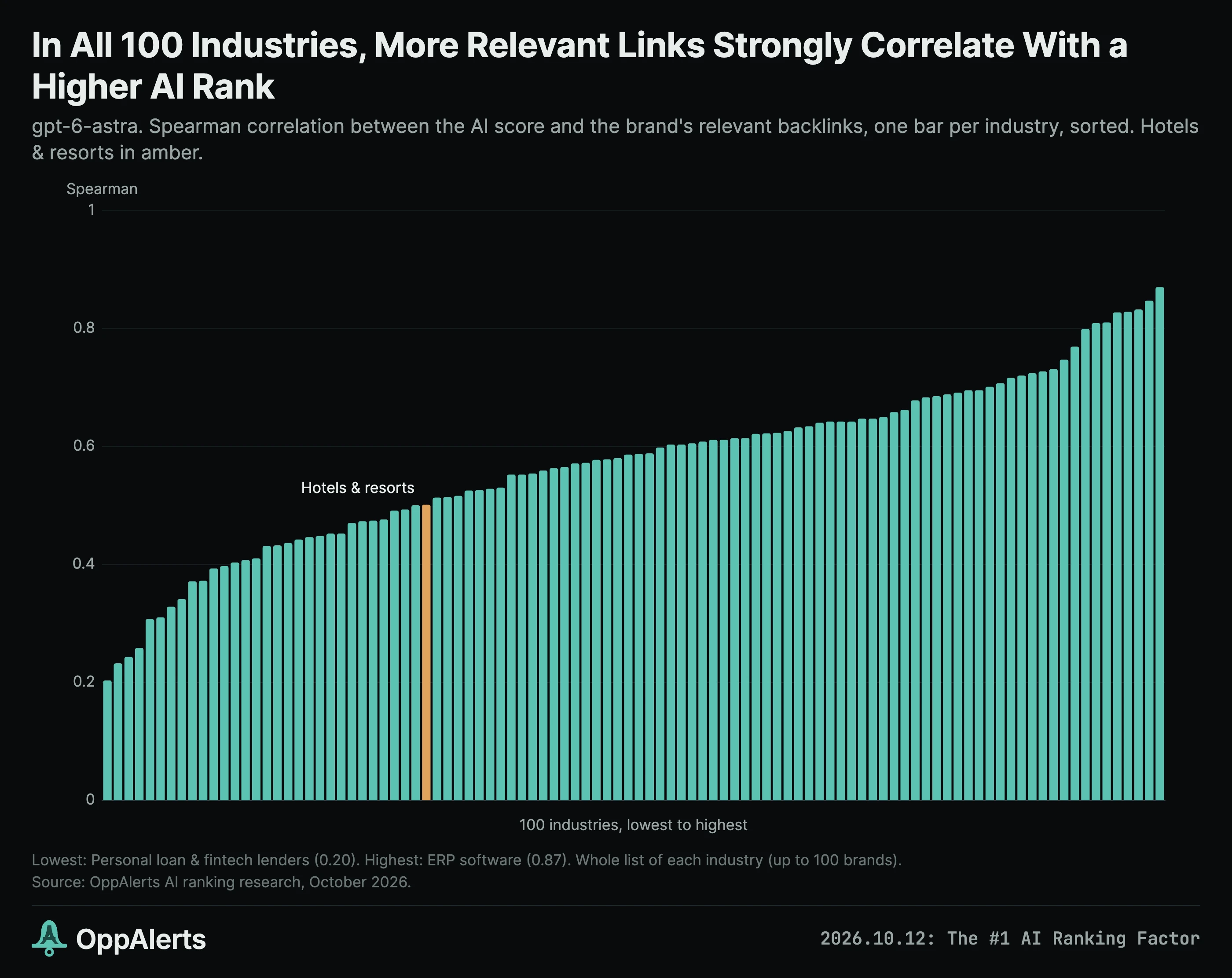
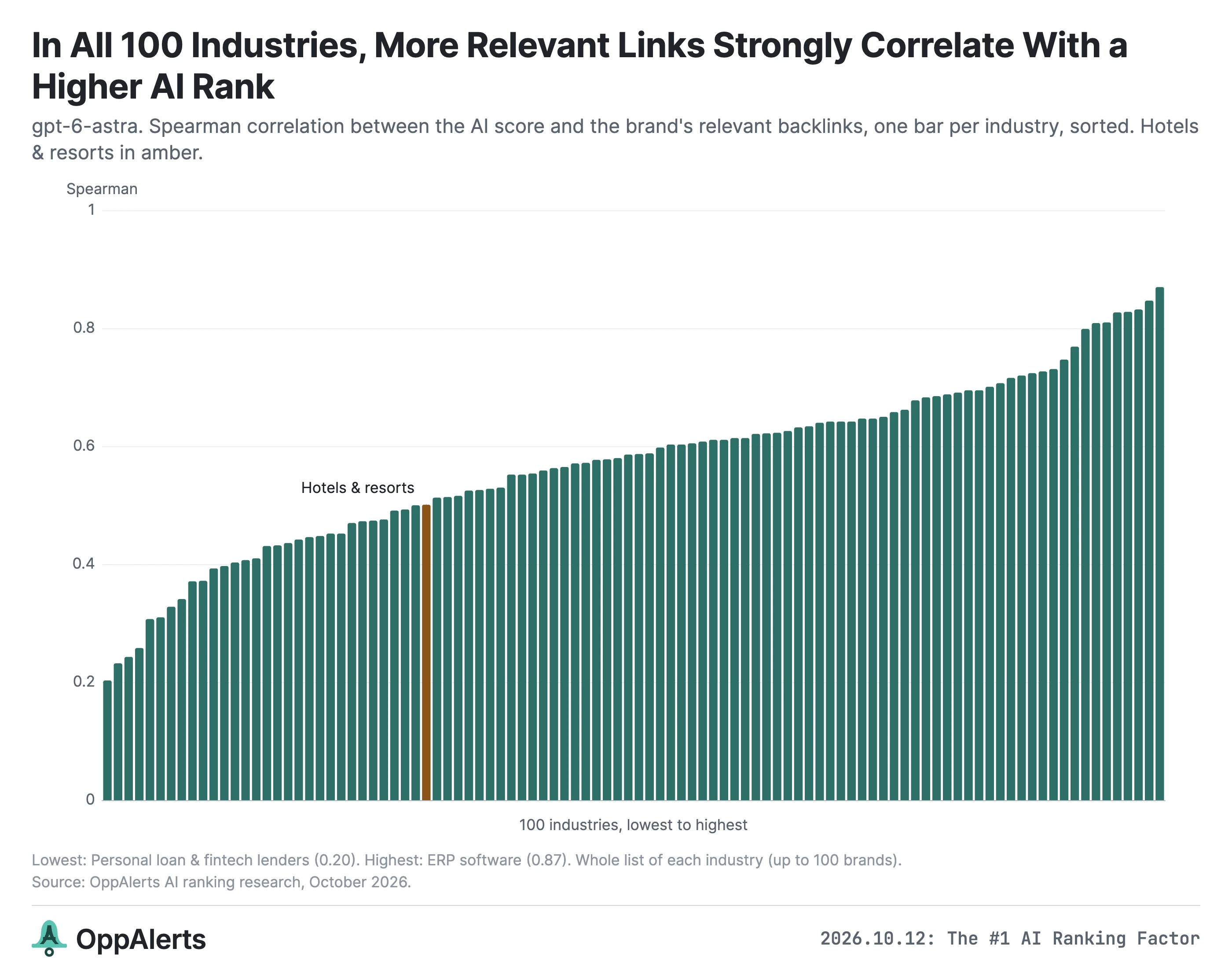
Relevant backlink counts and AI scores have a positive correlation in all 100 industries.
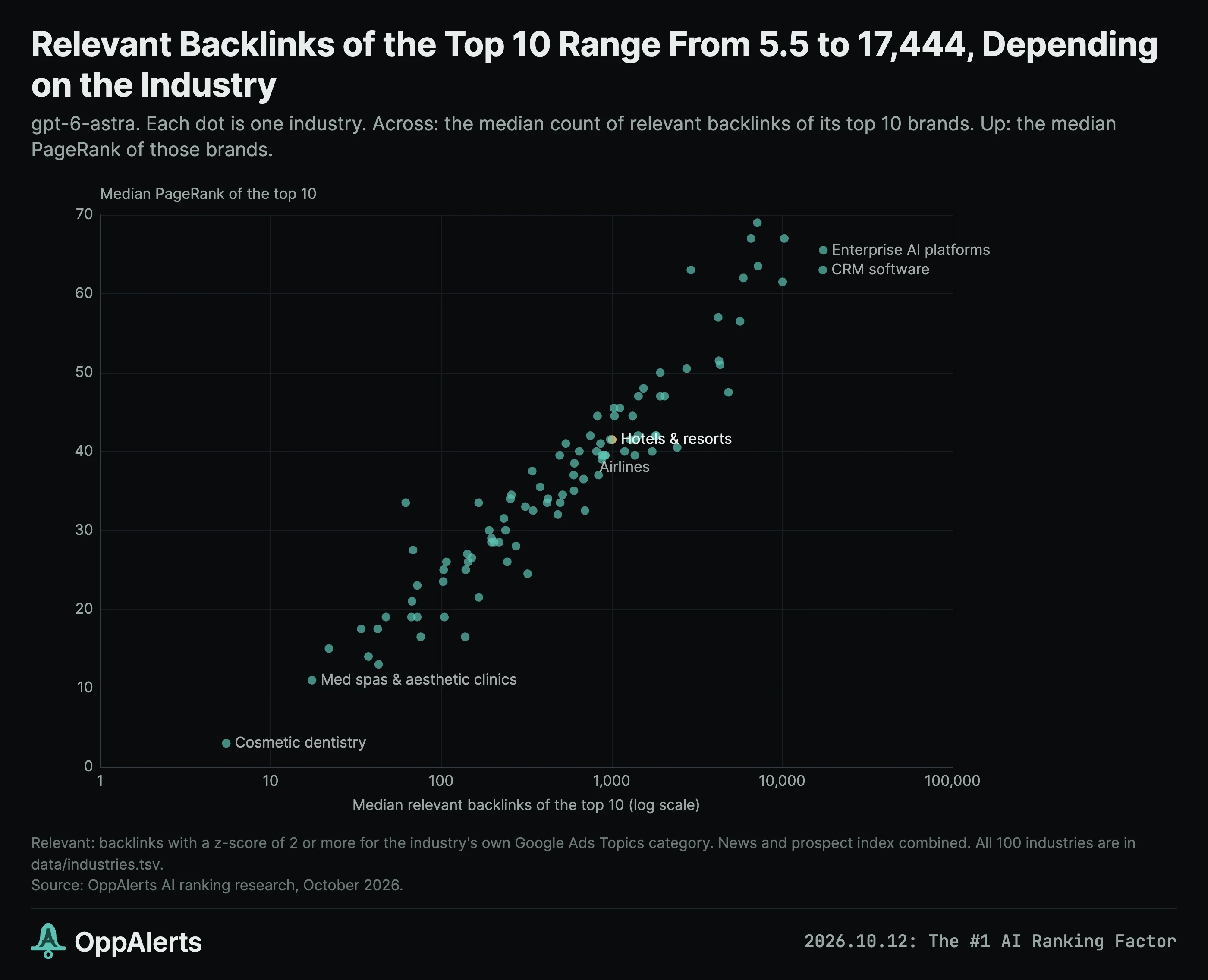
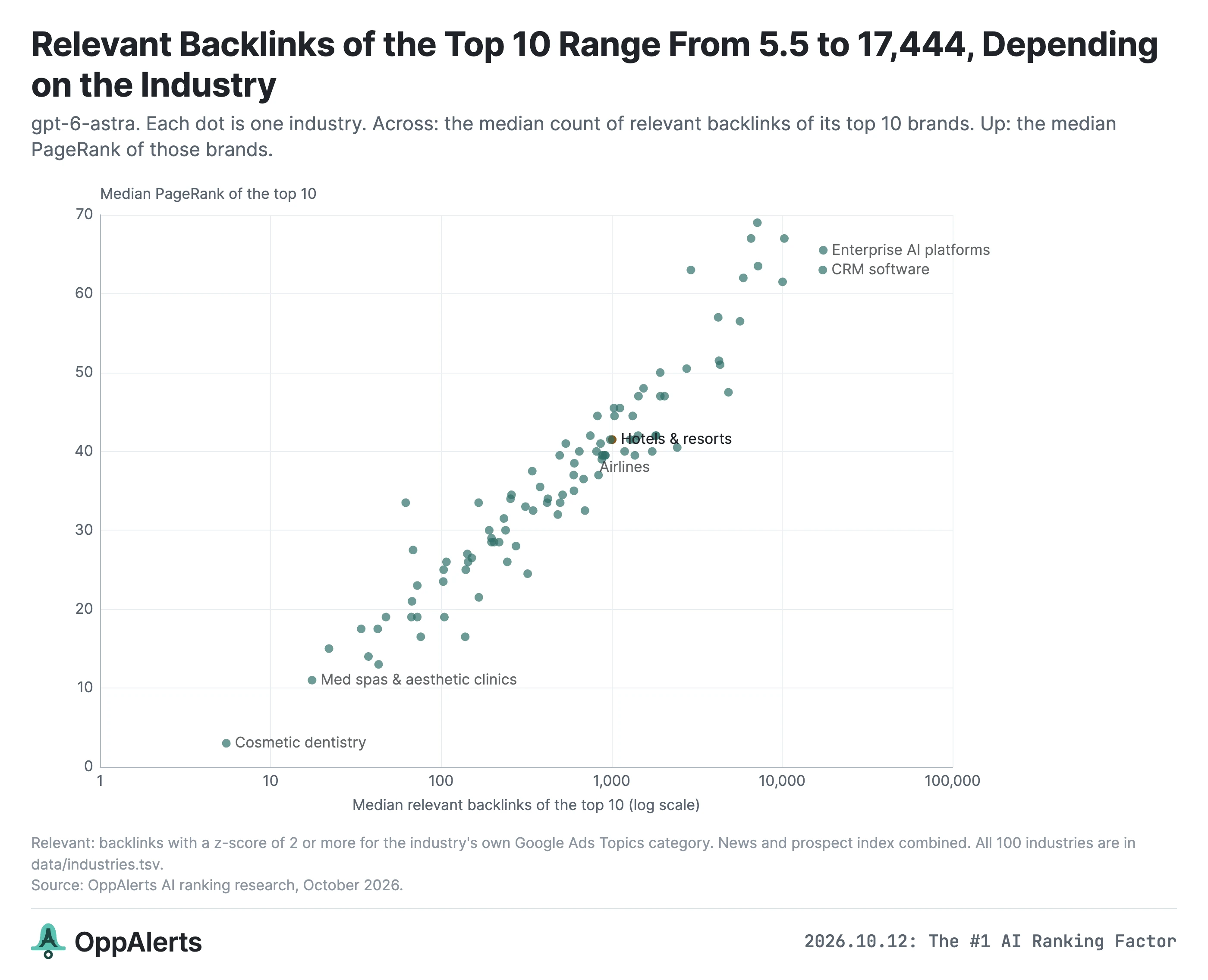
The median relevant backlink count for the top 10 changes significantly from one industry to another.
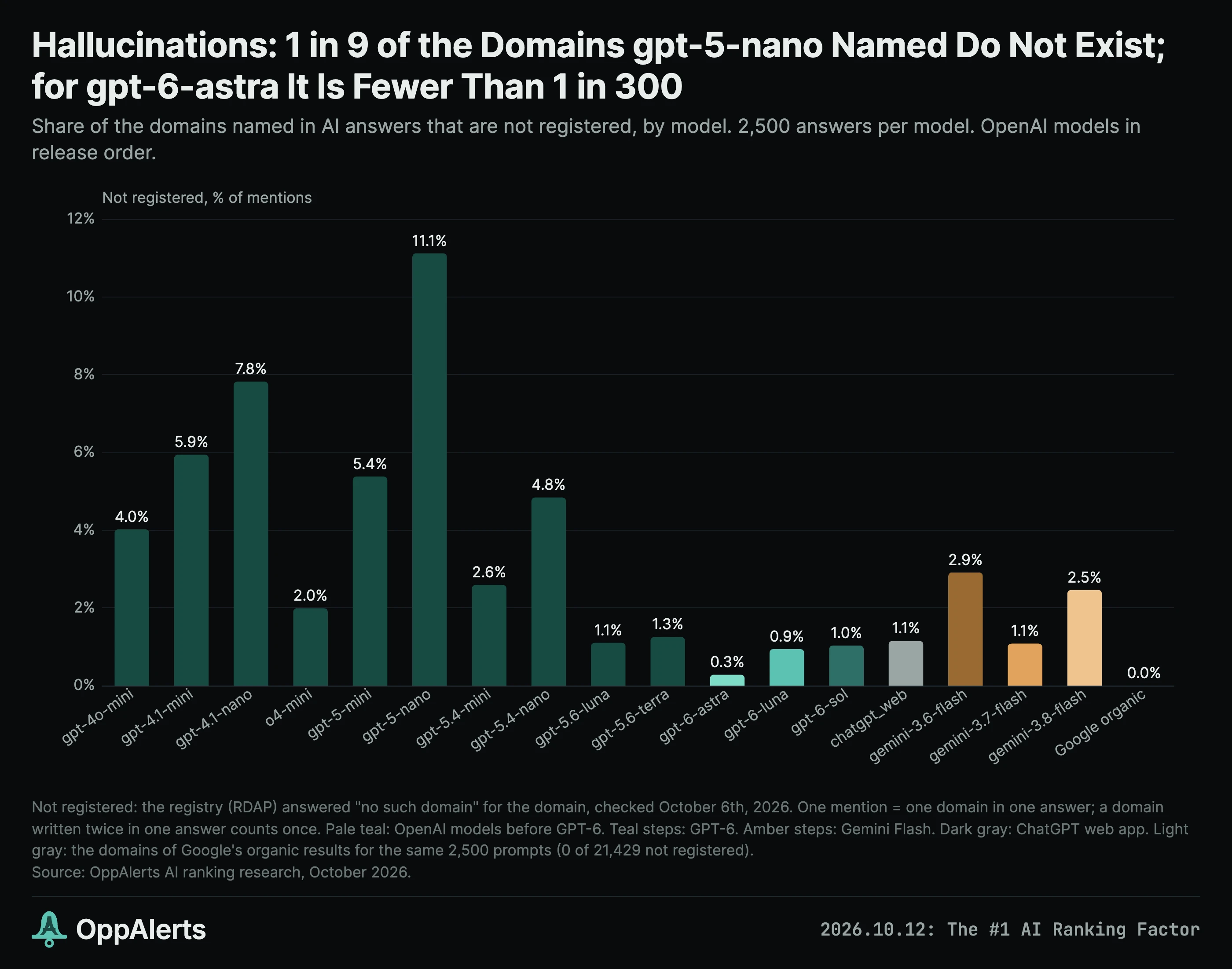
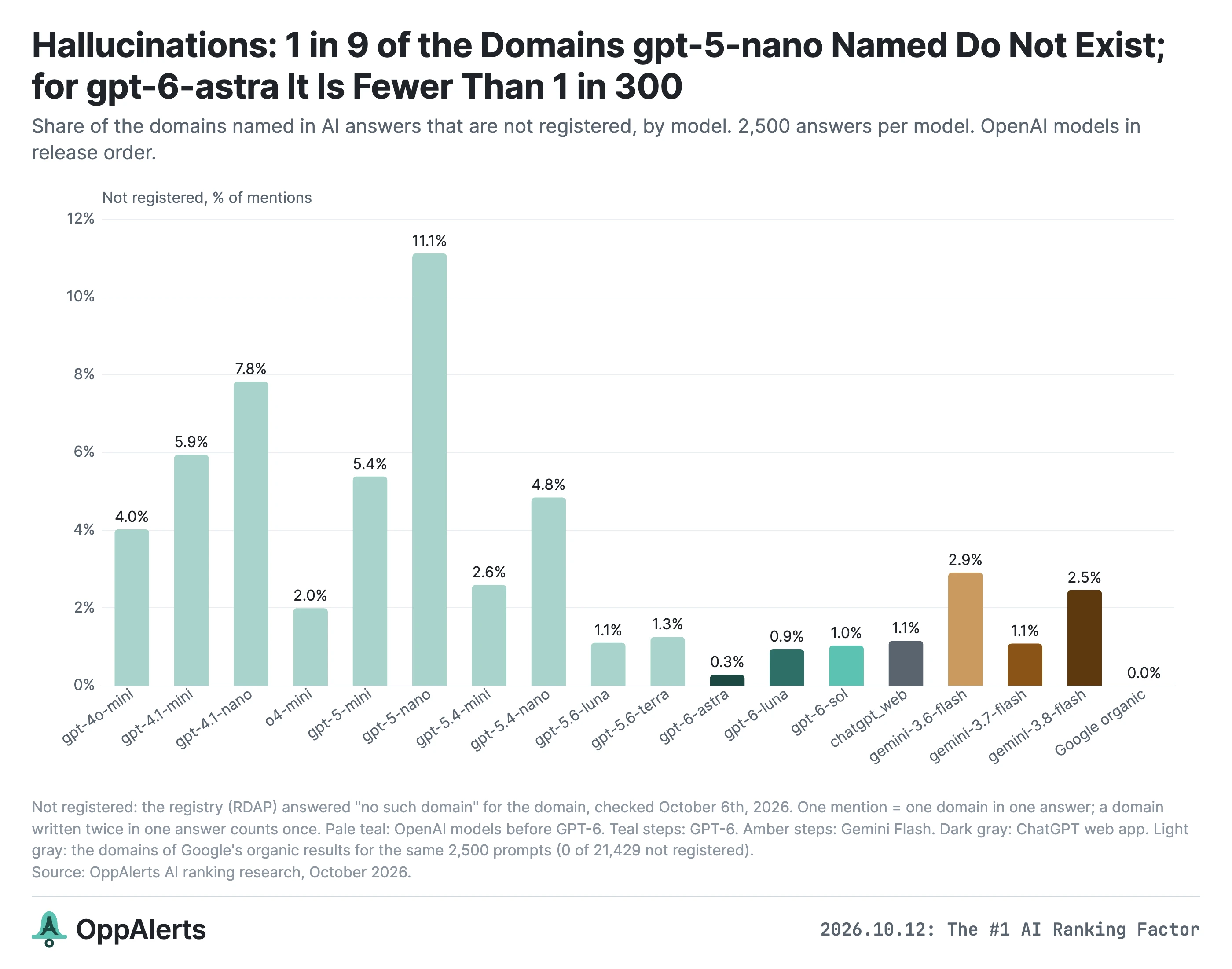
How often a model recommends an unregistered domain varies significantly by model.
What to keep in mind
- I compared brands as they were. I did not add links and then measure what changed. My view is that this relationship is causal, but this study does not prove causation.
- The measure here is backlinks from contextually relevant pages. The context of the page matters.
- This study does not give you a formula for how many links will move a brand a certain number of positions.
- The counts come from the OppAlerts news index and link and marketing opportunity index. Those indexes cover part of the web.
- I used broad industry prompts. I did not test every persona, location or price range.
- “Not registered” means I found no registration in ICANN zone files, RDAP or DNS on October 6, 2026.
How I tested it
For each of 100 industries, I asked 13 OpenAI models, three Gemini models and the ChatGPT web interface for the top 25 brands. I asked 25 times, using 25 different wordings, then combined the answers into an AI score. Next, I used OppAlerts to find the pages linking to and mentioning each brand, and compared each page with 5,970 categories from four taxonomies. You can find the key tables in the research overview and the full method in the blog post.
Interviews
For an interview with Ben Wills, get in touch. You can find his background and the other research in the media kit.