PageRank History lets you see how a site's PageRank has changed across monthly measurements. PageRank over Time, or PRoT, adds those monthly values together. You can use the history and accumulated total to research how established a site is in the collected link graph.
Imagine two specialist magazines have the same PageRank this month. One has held similar values for years. The other has a much shorter record. Their current scores match, but looking at the history shows you a difference that this month's number alone can't explain.
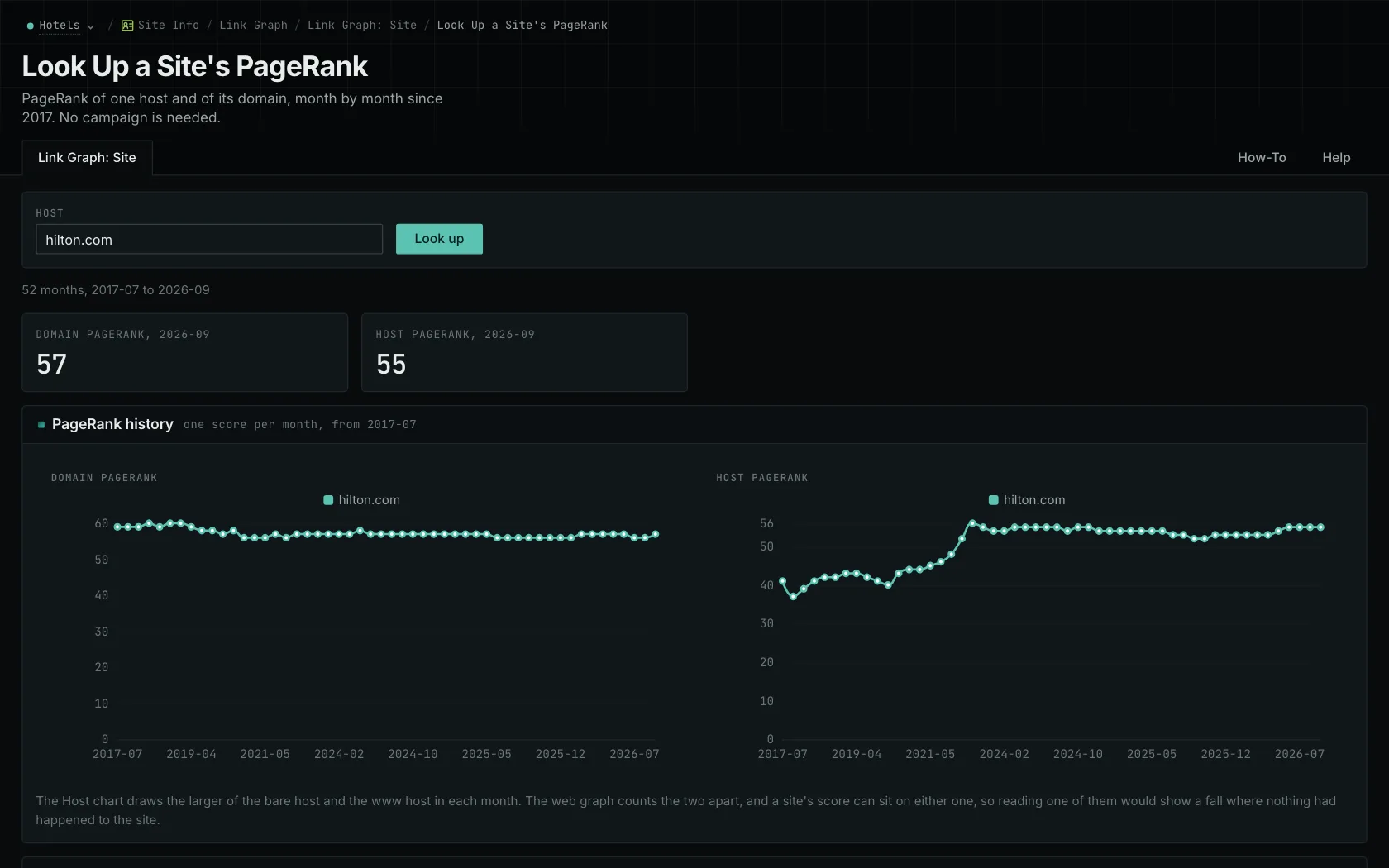
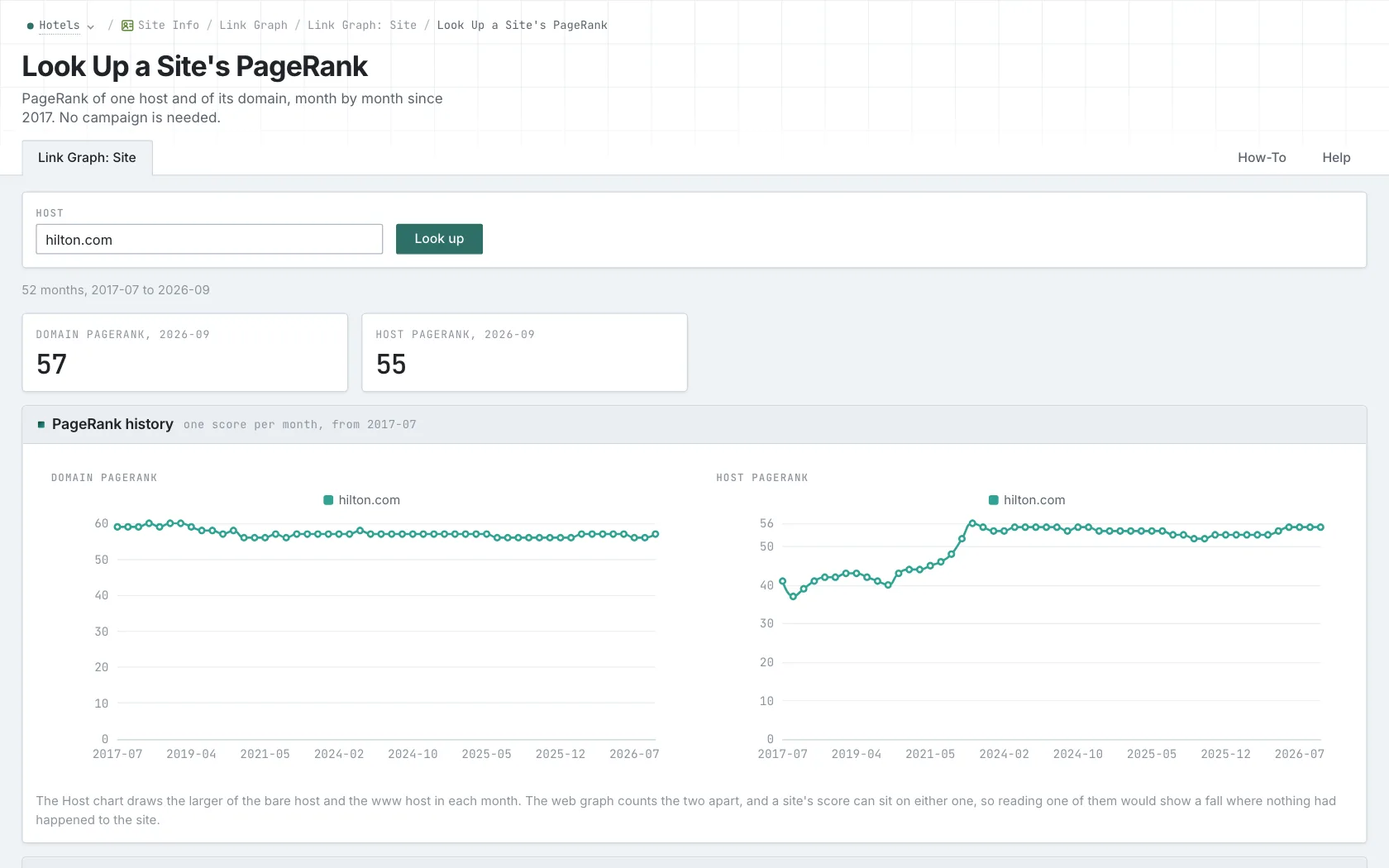
Look at how the total built up
PRoT is a sum of the monthly values. A higher total can come from higher scores, more months of history, or both. Open the monthly series to see how it developed. That history is useful for researching a publisher, but it doesn't measure readership or editorial quality.
Opportunity and brand page reports have minimum domain and host PRoT filters. Use them to narrow results by accumulated link history, then investigate the sites that remain. The Link Graph pages show the monthly PageRank series; they don't show a separate PRoT series.
A long decline might give you a reason to check whether a magazine still publishes and maintains its archive. A sustained rise might lead you to look at its recent work and referring sites. Read the current publication to understand it. A small specialist site may still reach exactly the audience you want, even with a low score.
Compare the same kind of site record
Link Graph: Site shows Domain and Host values for one website. Multi-Site lets you compare several. Domain covers the registrable domain. For each month, Host uses the larger available value from the requested host and its www variant. A publication on a separate subdomain remains a different host. The underlying data keeps domain, bare-host, and www records separate; the page combines the two host records for the Host display.
Here's an anonymized example from the source data. Through December 2025, the bare host has a value of 56 and www has 0. From January 2026, when the source separates bare hosts from www variants, the values are 31 and 56. The displayed Host value stays at 56 because it uses the larger value each month. That change in the source records doesn't, by itself, show a change in the publication's activity.
If only one host value is available, the chart uses it. If neither is available, the month stays empty. A gap means there's no measurement to display for that month.
Use the history when choosing prospects
The charts contain monthly observations starting in July 2017. The latest point is the most recent completed monthly measurement, so check the current website too when deciding whether to pursue it.
You can compare up to 100 hostnames in a batch, entered one per line or separated by commas. Full URLs are reduced to hosts. If you enter more than 100, the request is refused and the supplied and allowed counts are shown. Shorten the list before running the comparison.
These values come from the collected link graph. They aren't traffic estimates, topic-relevance scores, or scores supplied by Google, and you can't directly substitute numbers from another dataset.
Use the history alongside the publication's current work, audience, and contribution requirements. Together, those help you decide whether it's a place where your business should build a relationship.
The guide to reviewing a prospect's history walks through the checks.
See how OppAlerts fits your work.
Tell me what you are working on and what you need to find out. I can walk you through the relevant reports and explain what OppAlerts can help you do.
You can explore the demo first, or use this form to ask about a task or arrange a demonstration with me.